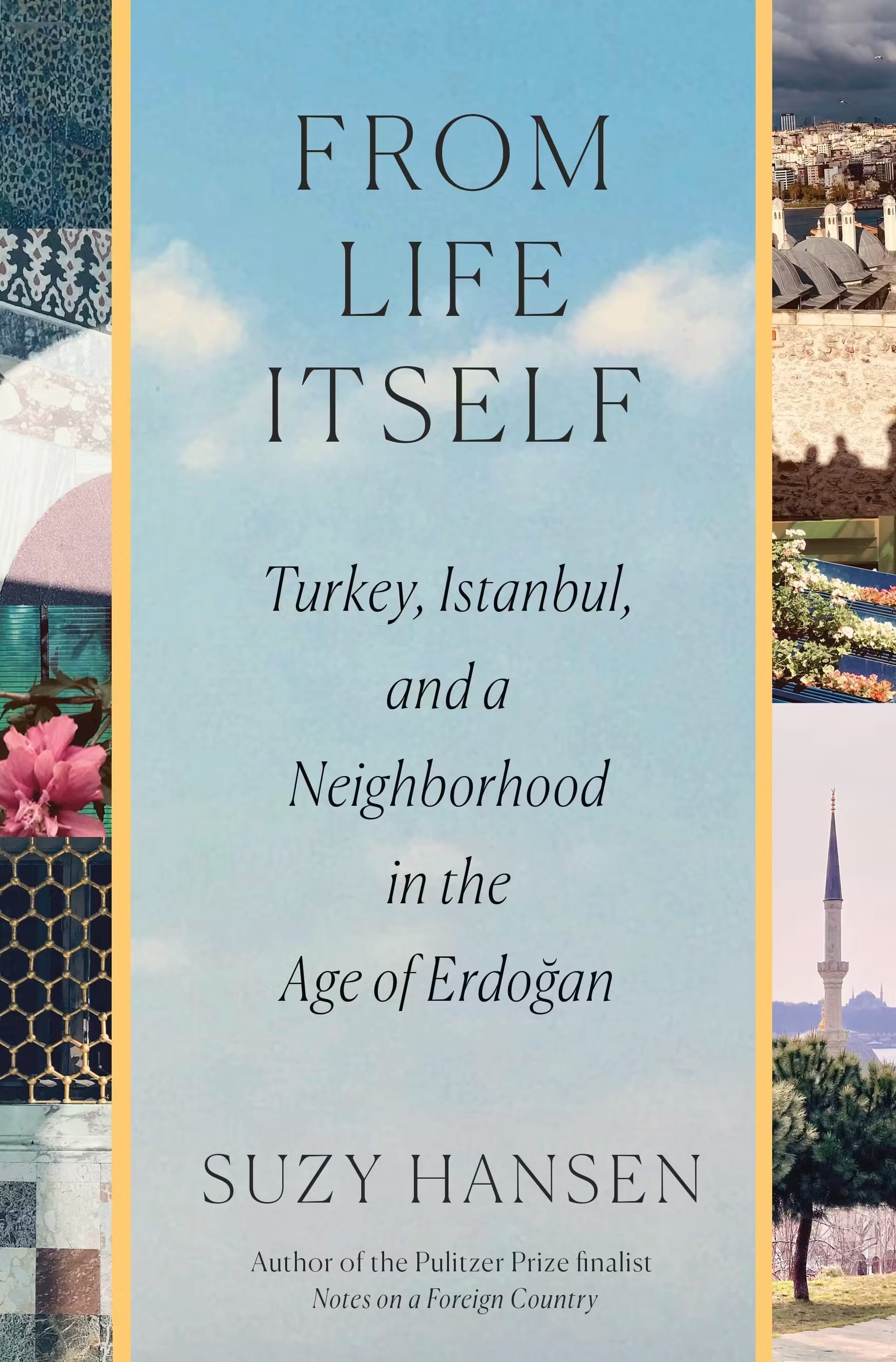
I have to admit: I’ve had a really bad run of nonfiction books lately. All of them have been positively reviewed, some in terms that are magnificently glowing. Many of them have even won prestigious global awards. Time after time after all of the hubbub, I finally get around to making a purchase, bring a tome home, sit down in a comfortable chair, and steel myself for deep meditative attention on the text…
… only to find my disappointment inevitably arrives. Sometimes it’s after only a few pages when I can just tell that the author has all of the style of greige cement, or that the claims the book sets out are so bombastic or Manichaean that the rest of the book is guaranteed to be an intellectual slog. Oftentimes it’s not the intro but just the numbing page-after-page nightmare of a somnolent narrative that has nowhere to go. “Why isn’t this an article,” I’ll say —only to find out that it was. “Touché.”
So I’m a bit energized to report that Suzy Hansen’s From Life Itself doesn’t fall into the obvious traps of contemporary nonfiction. In fact, it’s one of the most rewarding works of reporting I have read in sometime.
We’re all aware of Turkey’s political changes over the past few decades under Erdoğan. But awareness is not understanding, and falls well short of wisdom. The Eurasia straddle power is probably the top five or ten most important country in the world right now to study, simply because it sits at so many global crossroads of politics, society, culture, religion and economics.
Hansen has done something extraordinary: she has reported on a country that is often synoptically airbrushed in news coverage and given it more humanity than I thought possible in contemporary nonfiction. She’s lived in Turkey for 15 years, and it shows in her concision and thoughtfulness, but also in the very definition of her project. Her vocation here is that of the classic foreign correspondent with the time (and enough funds to afford time) to properly report a story to an audience that has no idea what is really happening on the ground. She does what a great book should do, taking a simple if ambitious thesis and complicating our understanding all while bringing wisdom to bear. This is how she describes her work in the introduction:
What I didn't know was how and why Erdoğan, a poor boy from the backstreets of Istanbul, pulled off such a feat. The existing explanations were unsatisfying. In the years after Trump and Brexit, Western pundits and Western politicians divided the world between democratic and authoritarian countries, and Erdoğan found himself lumped among the strongmen, including Vladimir Putin, Viktor Orbán, Narendra Modi, Rodrigo Duterte, and Donald Trump. The list didn't make sense to me. All of these countries were so different, their histories distinct. Westerners wanted to believe these men were systemic aberrations, disruptions to some preordained timeline of democratic progress, but I knew Erdoğan was the sum of myriad Turkish traditions and influences, so many of which were authoritarian, populist, and imperialist. I also knew that Erdoğan's popularity, while amplified by his relentless propaganda, was the product of genuine political and social achievements, real improvements for his people. He believed he was restoring a loss of Turkish dignity, salving the wounds of millions of Turks who felt disparaged by the West and by their own elites, and seeking for himself and his people something Turks had always wanted: autonomy. Even if Erdoğan had always dreamed of creating a new country, the old one must have been broken enough to suggest he could. The question seemed less why democracy was failing, and more why twentieth-century nation-states weren't surviving the twenty-first.
This comes a few pages into the book, but it entranced me with its balance and thoughtful detachment. In the histrionic culture wars of Twitter, such a careful examination of a complex subject is just anathema to the medium. This paragraph is 1,492 characters in a 280 character world, and it’s perhaps the best distillation of why printed books still matter.
How does she take on such a Byzantine subject? (Sorry, had to do that at least once). Different authors trying to characterize the zeitgeist of a country have multiple approaches to work with. There’s the biographical approach, with The Power Broker coming to mind. You can track down the rebels and oddballs, illuminating what a culture will accept and what it finds scandalous. A book like Yi-Ling Liu’s The Wall Dancers is a good recent example. You can zoom in on a social class, offering a soft sociological study of a group of people and how they are making change happen like Strangers in Their Own Land. You can also zoom into an institution — an advocacy group, a council of advisors — and highlight that group like the Federalist Society in The Rise of the Conservative Legal Movement.
Hansen has chosen a relatively rare approach: her’s is that of a neighborhood study of Istanbul’s Karagümrük, where she lived for some time and came back regularly to report. It’s a neighborhood that has seen history in a way that is impossible to grasp from a city like New York — empires rising and falling, whole nationalities arriving and disappearing, decades of triumph and reversals and now a hollowing out of lives and little luxuries.
Her narrative is buttressed by about half a dozen key characters and another dozen or so supporting cast whose relationships, backstories and present politics offer the reader a panoramic view into modern Turkey. She has carefully cultivated her contacts to offer a breadth of perspectives and the lived diversity of actual humans with contradictory views.
She is an able guide through the history of the past one hundred years of Turkey, showing how changes from the fall of the Ottoman Empire in World War I have meandered to the present day (the Menderes River from which the term derives flows in Turkey’s west). But the bulk of her work is on the rise of Erdoğan, first as mayor of Istanbul and then as prime minister and president over the past two-plus decades. She is fortunate that her main interlocutor knew Erdoğan as a boy, and occasionally ran into him in his work and play.
Through her characters, she describes the highs and lows of an imperial forever leader. There was elation following the cleansing of corruption and the building of Istanbul’s infrastructure that was desperately needed, followed by the inevitable despair over graft and the small coterie of well-connected firms who exploit the regime for its own pecuniary interests. But even here, opinions among Hansen’s sources vary, with different people hopeful that the better past will return and others angry that the present is so miserable.
Hansen’s neighborhood of Karagümrük has become a way station for Syrian refugees from the decade-long struggle between Assad and rebel forces that ultimately resulted in Assad fleeing to Moscow and Syria being taken over by an al-Qaeda affiliate (whose leader, Ahmed al-Sharaa, was just invited to the G7 conference in France). Opinions on the Syrians vary dramatically, much as they do about immigrants in any Western nation. Hansen — more than many writers I have read on the subject — seems to capture the little actions that make an impression on locals. Many of her Turkish interviewees complain that Syrians don’t walk correctly on the sidewalk, and the friction of walking the tight streets of Karagümrük is part of their distain. It’s so easy to dismiss, and yet, that’s often the kernel for harsher relations long term. Hansen offers no grand theory of race relations or global asylum, but just honest reporting that’s often mundane yet far more powerful for it.
From Life Itself isn’t a propulsive read, despite a framing plot scene in the prologue whose resolution is saved for far deeper into the book. Nevertheless, I really couldn’t put the book down. Part of the reason is that even though I knew what event was about to happen next, I didn’t know how any of the characters in the book would respond. It reminds me about the definition of a good think tank: every once in a while, it should say something surprising. Otherwise, why read?
The downsides of Hansen’s neighborhood study are obvious. Karagümrük is poor, and as such, it doesn’t represent the moneyed elites that almost certainly view Erdoğan in a much more positive light. The cosmopolitan environs of Istanbul is not where Erdoğan’s power base resides, and while she does note that metropolitan-countryside relations are a key factor in understanding populism, she does little to rectify that problem, with nary a foray into a village to widen her aperture. The limited exception is through her characters, who often have some family still living outside her city.
She also rests far too much of her pro-Erdoğan coverage on a single barber, who I appreciate is regularly present in the narrative, but which nevertheless feels like the stereotypical observation that foreign correspondents merely talk to their taxi drivers to get the local scoop. A few more voices who supported the government wouldn’t have hurt the book.
Ultimately, these are quibbles. From Life Itself is a magnificent example of the lost art of empathetic foreign reporting. It’s constantly searching for deeper truths in a complex world filled with superficial ones. A great nation like Turkey deserves a great book explaining it, and for once, we’re the beneficiaries of just such a treasure.