I tend to read older cultural criticism with one of two minds. One is the delectable schadenfreude of witnessing previous moral panics that ultimately turn out to be hysterical outpourings of stupidity (I’m thinking of Dungeons and Dragons and how it will cause children to become Satan-worshippers). That haughty superiority of retrospect is only tempered by the nagging concern of identifying which of today’s moral panics are equally imbecilic (my vote is birth rates and natalism, but who knows).
Second is the value of just understanding an era’s concerns as a lens to understand its history. Reading contemporaneous opinions of, say, the Civil Rights movement can remind us of the stakes involved, the contingency of history, how different groups ultimately triumphed or failed, and how historians tends to burnish or punish the reputations of people in the long run.
Every once in a while though, you read a book of criticism that is both decades old and also feels like it could have been published yesterday.
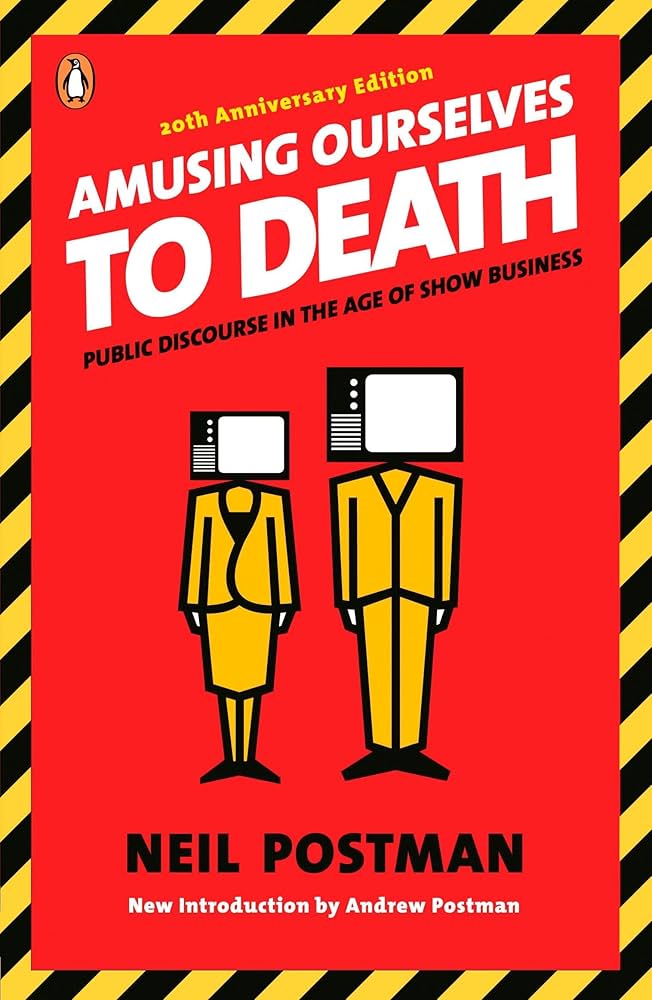
Neil Postman wrote Amusing Ourselves to Death in 1985, and he was taking on the power of the boob tube (aka television) and its increasing dominance of American public life. This was the time of Ronald Reagan, a popular Hollywood actor, as well as televangelists like Jerry Falwell, but just a few years before CNN and the first Gulf War would truly transform the conduct of war and peace. It was a transitory moment for media, and Postman is writing a Buckley-esque (“standing ’athwart history, yelling Stop”) cri de coeur here against the video box in our living rooms.
What’s astonishing about Postman’s critique of television is that the trends he was observing have intensified a hundred-fold with the advent of social media. He criticizes the context-less form of television programming, which must always assume that a viewer has just flipped on a program and knows nothing going on. Dramas offer no continuous plot lines, news programs devote just a few minutes to complex issues before moving on to something more lighthearted, and political “debates” go from the seven hour affairs of Lincoln-Douglas to the rebuttals-in-sixty-seconds ridiculousness of today’s matchups.
As he notes with his dry sense of humor, “We have become so accustomed to [television’s] discontinuities that we are no longer struck dumb, as any sane person would be, by a newscaster who having just reported that a nuclear war is inevitable goes on to say that he will be right back after this word from Burger King…”
Postman strenuously argues that the medium isn’t neutral here, but fundamentally warps communications and our very thoughts to fit the screen and not vice versa. Television could of course offer hours of instructive and intellectual programming, and viewers could likewise expect to be elevated in their wisdom each evening. It doesn’t, of course, for what works well with the medium and the mechanics of money behind it is precisely the opposite. Everything must be julienned into 30-second bite-sized increments, lest attention wander.
Unsurprisingly, he places paramount importance on the printing press and the affordances of text that allow a reader to ponder complex issues and their encompassing logic. In not so many words, the Enlightenment was nothing more than putting thought to paper, since the very nature of print meant that argumentation had to be sharpened, discourses had to be evidential and rigorous, and the permanence of text meant that ideas could float in the marketplace of ideas and rise or fall meritocratically.
Surprising to me having read Richard Hofstadter’s Anti-intellectualism in American Life, Postman argues that America’s first two centuries were a time of extraordinary bibliophilia. Americans of all social classes were much more literate and bought many more book than their English counterparts, and the per-capita sales of books like Thomas Paine’s Common Sense were astronomical then and would be on the par of a Harry Potter or other franchise title today. I’m not adept enough of the history here to parse through these claims, although I was awestruck at some of the statistics on early American publishing.
Postman dates the transition away from America’s literary and textual public square to the rise of the telegraph and the related advent of the photograph. “The telegraph is suited only to the flashing of messages, each to be quickly replaced by a more up-to-date message. Facts push other facts into and then out of consciousness at speeds that neither permit nor require evaluation,” he writes. The well-organized and considered pamphlet that had undergirded U.S. political thought among elites and workers alike during the Revolutionary War and into the Civil War was suddenly replaced by the random noise of “news of the day” announcements.
He’s particularly caustic on how that transition affected the mobilization and agency of citizens. “Thus, you have a great loop of impotence: The news elicits from you a variety of opinions about which you can do nothing except to offer them as more news, about which you can do nothing.” We learn about the weather to understand whether we need to take an umbrella with us. Suddenly, Americans were getting hundreds of dispatches from across the country and around the world, but what was the point?
The telegraph’s context-less news needed a human face in Postman’s telling, and that came by way of the photograph. The photo provided the visual context for the short snippets of context-less text that arrived by telegraph, merging together into what Postman dubs a “meta-medium.” Ultimately, that meta-medium would evolve into the modern medium of television.
Postman offers reams of examples from the 1980s of television’s influence on different domains. Arguably buttressing his logic is the fact that the vast majority of the names were still recognizable to me, the fame of these news anchors and politicians and entrepreneurial voices having been seared into the American conscious given their broadcast stature.
But reading this book in 2026, I can’t help but be dumbstruck at how much a work of contemporary criticism holds up. Donald Trump is the apotheosis of television’s ethos, who has somehow managed to imbibe its context-less form of communication into his everyday speech. Every presser he composes is framed for television, and it’s widely known that he prioritizes people “from central casting” in selecting for major cabinet roles. The attention span of television matches that of his administration.
CNN recently did a compilation of the president talking about winning in Iran. It’s absurd when you place all of the 39 clips side-by-side, but that’s not how viewers see them, of course. Instead, each day when viewing television, they see the president parroting his line of victory with no present context nor historical memory of what was said previously. “… in a world of discontinuities, contradiction is useless as a test of truth or merit, because contradiction does not exist,” Postman writes. Trump’s brilliance is pushing that wisdom to the asymptote.
Then there is social media. If the telegraph and television offered context-less news from nowhere about nobody, it’s more of the same but just at mach speed. He notes that a recent study analyzed TV programs and found that each camera shot lasted about 5.7 seconds on average (I am quoting that stat from memory). On TikTok, best practices say that shots should last a maximum of 3 seconds and ideally only 1.5 seconds to keep viewers engaged. Yes, we are indeed amusing ourselves to death.
Clearly, things have gotten worse instead of better, which is ironic, because that was precisely Postman’s solution to the problem of television. “We would all be better off if television got worse, not better,” he concludes. His point was that entertainment shows posed little threat to society, but turning news and political discourse into entertainment was exceedingly dangerous. That’s exactly where we find ourselves now.
Unfortunately, just as the world has gotten ever more riven with challenges, we’re increasingly remote from exactly the media that offer us the best purchase on that complexity, namely written essays and books. Nonfiction book sales are down this year, likely for the same reasons that I complained in yesterday’s review of Suzy Hansen’s excellent From Life Itself. Authors themselves are just as Twitter-adled as their readers, and are unable to compose a profound work that will move the mind as they once could. The modern economics of publishing also precludes spending 5-10 years on a single work.
Modern references to Postman’s book tends to be synoptically focused on his title, which is certainly memorable. His message that entertainment is undermining civil discourse is important, but its most powerful lines of argument are the risks of being beholden to a medium that ultimately leads us far away from our own goals. I wish Amusing Ourselves to Death merely offered us schadenfreude about the past. Instead, it’s nothing short of a cautionary tale that yes, we can amuse ourselves even closer to death than ever before. And now, a word from Burger King.
FYI: I use no AI in the drafting of these posts. That also means that all typos and errors are human-made by yours truly. Any complaints about my regular use of em dashes may be sent to your own Claude bot for disposal.