North Korea’s opacity is all but impregnable. Its neighbors, Russia and China, are dictatorships that work ever more diligently to control the speech of their citizens, but the two have got nothing on the Hermit Kingdom’s totalitarianism. Even the most rudimentary facts about what’s happening in the country are all but unknown to the outside world. In fact, the situation has gotten worse: the most valuable and reliable source of ground truth used to be defectors, but their numbers have slowed to a trickle ever since Covid-19 caused the country to tightly seal its border.
That totalitarianism has also meant complete narrative control of the country’s history and politics. No regime better stagecrafts its leaders and their biographies. That’s as true of Kim Jung-un today as it was for his grandfather and North Korea’s founder, Kim Il-sung. Unearthing what is fact and fiction is an extraordinarily challenging endeavor against a state that does everything in its power to disappear inconvenient facts (let alone people) and fervently broadcasts myths.
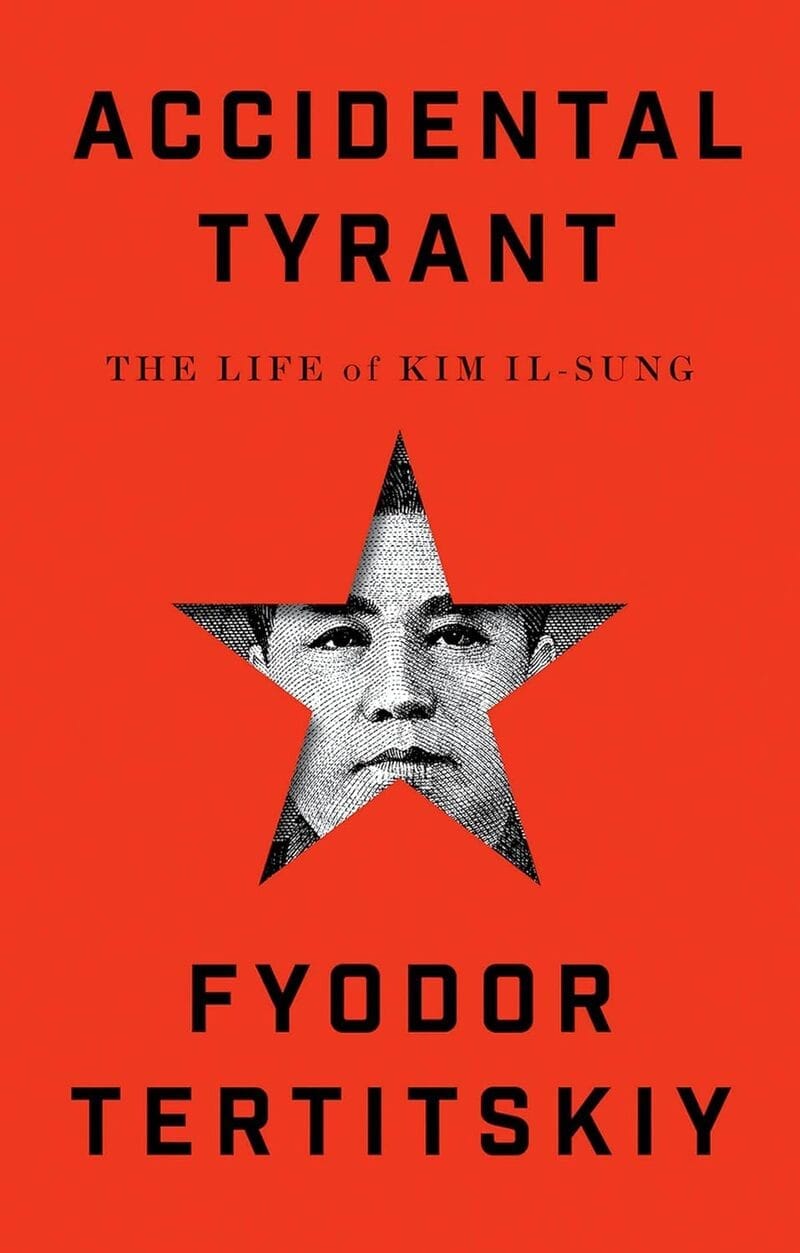
Fyodor Tertitskiy tries to cut through this morass in his compact biography of the elder Kim in Accidental Tyrant. This is an academic book published by Oxford, but it’s a largely readable account of Kim’s early years, his rise to power in the late 1940s, and the changing nature of his rule before his death in 1994. As the title implies, Tertitskiy’s argument is relatively benign: Kim’s success in founding and running North Korea was by no means a fait accompli. In fact, the Soviets had nearly complete control of the outcome, and Kim mostly survives due to their distractibility.
Compared to behemoth works where truth and fiction seem to flow together at times (I’m thinking in particular the 912-page Under the Loving Care of the Fatherly Leader: North Korea and the Kim Dynasty), Tertitskiy uses a scalpel to identify exactly what is known and verified in the historical archives and admits to what is ambiguous or unknown even today. That means that coverage of Kim’s childhood is much less robust than what one would hope, but the account offered here is also on much more solid ground.
It gets more interesting as Kim gets involved with Korean independence and the fight against the Japanese in the 1930s and 1940s. His actions in this period are among the most debated among academics in the field, and for good reason: their resolution predetermines the story of the North as an historical force. Tertitskiy is even-handed, pointing out that while Kim committed early and tirelessly to the cause, his unit wasn’t all that influential in the outcome. He writes, “As for the Eighty-Eighth Brigade, the unit did not participate in the war at all. In fact, the brigade was all but forgotten.”
That situation appeared to be just fine for Kim, who was ultimately brought to North Korea directly by the Soviets as a leader who could be easily controlled by Stalin. While this Soviet involvement in his selection remains heavily politicized by academics, the evidence now available from Russia’s archives is overwhelming. That’s also the case for Kim’s decision to go to war against South Korea, a war that neither Stalin nor Mao wanted to support but ultimately relented on. The cost of the war was extraordinary, and it’s now easy to see that Kim made a tremendous strategic blunder, expecting to be greeted as a liberator upon his success in taking Seoul and finding little support (where have we heard that one before?).
Kim was forced to consolidate power for the remainder of the 1950s. Tertitskiy shows conclusively that the Soviets had unilateral control over the North throughout this period. However, the key to Kim’s rise even against the wishes of the Soviets under Stalin and then Khrushchev is that the country repeatedly sent disgraced and fallen officials to become ambassador to North Korea. As the author writes:
One of the main reasons for Kim’s success was the personality of the then-Soviet ambassador, Aleksandr Puzanov, who like his predecessor Ivanov was a demoted Soviet official. As a man with little diplomatic and excessively cautious due to his recent fall from grace, Kim Il-sung could not have asked for a better man than Puzanov in order to achieve his aims.
Kim begins eliminating potential adversaries one by one through denunciations, demotions and plain old bullying. “In all, the period 1958–9 saw such a massive purge of high-ranking officials that the North Korean rubber stamp parliament—the SPA—lost more than a quarter of its members.” All of these actions could have been halted by the Soviets, and Kim himself could have been overthrown relatively easily. But the Soviets never intervene. When Kim assumes even more power directly against Moscow’s wishes, he’s braced for blowback, but it never comes. As Tertitskiy summarizes, “It was over. If the Soviet Union did not interfere when its advice on the issue of the top leadership was not followed, then its advice and commands could be ignored from now on.”
Contingency in history is, of course, a debate about counterfactuals. Was everything just luck and fate, or did individuals have agency that could have radically changed the outcome? Tertitskiy’s argument is that Kim caught one lucky break after another, and while politically astute, he never would have survived if he had really triggered the Soviets.
My view — both in life and while reading the book — is contingency mattered less than strategic agency. Kim seems to have known precisely how far to push and not farther. It reminds me of the line about the difference between a game of chance and a game of skill is whether you can purposely lose (you can’t purposely lose the lottery, for instance). Kim obviously could have purposely lost his position and nearly did, and so he was playing with skill.
In comparison to the depth of this decade, the 1960s to the 1990s are a real blur. The paucity of primary materials from this era is largely to blame, but it’s also the case that the totalitarian patterns of North Korea are continuously perfected and the story is perhaps not all that interesting. Kim has the benefit of dying in 1994 before the large-scale famines that would immiserate the North Koreans and would have largely upended his carefully crafted image as the savior of his people. Was this luck again? Or did the lack of an independent press ensure that his legacy couldn’t be tarnished by an economic system that he designed and that brought death to millions?
Outside of the core narrative, there are gems. The Soviets and Kim are arguing over what to call the new nation, with the options triggering different sensitivities. Tertitskiy writes:
Mun Il reported the discussion to Kim Il-sung, and Kim came up with an ingenious idea: call the country ‘People’s Democratic Republic’ in Russian as instructed but ‘Democratic People’s Republic’ in Korean. Thus, while it appeared to the Soviets that he was being obedient, it appeared to the Koreans that his position had been endorsed.
It’s the crafty legerdemains like this that make me lean far more toward skill than luck.
Accidental Tyrant is good history: rigorous yet synoptic, ecumenical but unafraid to tear down icons. Tertitskiy vows never to ascribe emotions to Kim or others that aren’t verified through letters and the like, which is appropriate academically but does make the narrative more austere than it might otherwise be. But on a subject of such sensitivity and with the truth under such duress, even an objective account that offers some transparency is a rebellion all its own.