A decade ago in graduate school, I was part of a reading circle on the sociology of quantification. It’s a small lacuna of an academic field with a massive scope: the incredible quantification of society and the politics behind how people and institutions construct those numbers. It encompasses everything from censuses (why are certain racial groups counted and others have no box to tick?) and GPAs/SATs in education to developmental indicators from institutions like the World Bank (some of which were shut down due to massive scandals) and HR performance reviews in companies (“Needs Improvement”).
With 8.8 billion people on the planet, 340 million in America, and more than a million people working at the largest companies like Amazon, every organization eventually succumbs to both the allure and the need of the quantitative indicator. There are just too many people and too much corruption (ranging from garden-variety favoritism of one’s friends to outright financial bribery) for there not to be a near-objective metric for how to evaluate everything.
Once you start to see the impact of numbers on society, it’s almost impossible to stop seeing new examples. In that way, the field has a way of drawing you in, since it seems to be groping toward a fundamental theory of social life. In the end though, it’s disappointing because there appears to be no path out of the morass of metrics. What do you replace evaluations with? Gut instinct? Even the most fervent believer of qualitative assessments admits to the massive bias inherent in such a project.
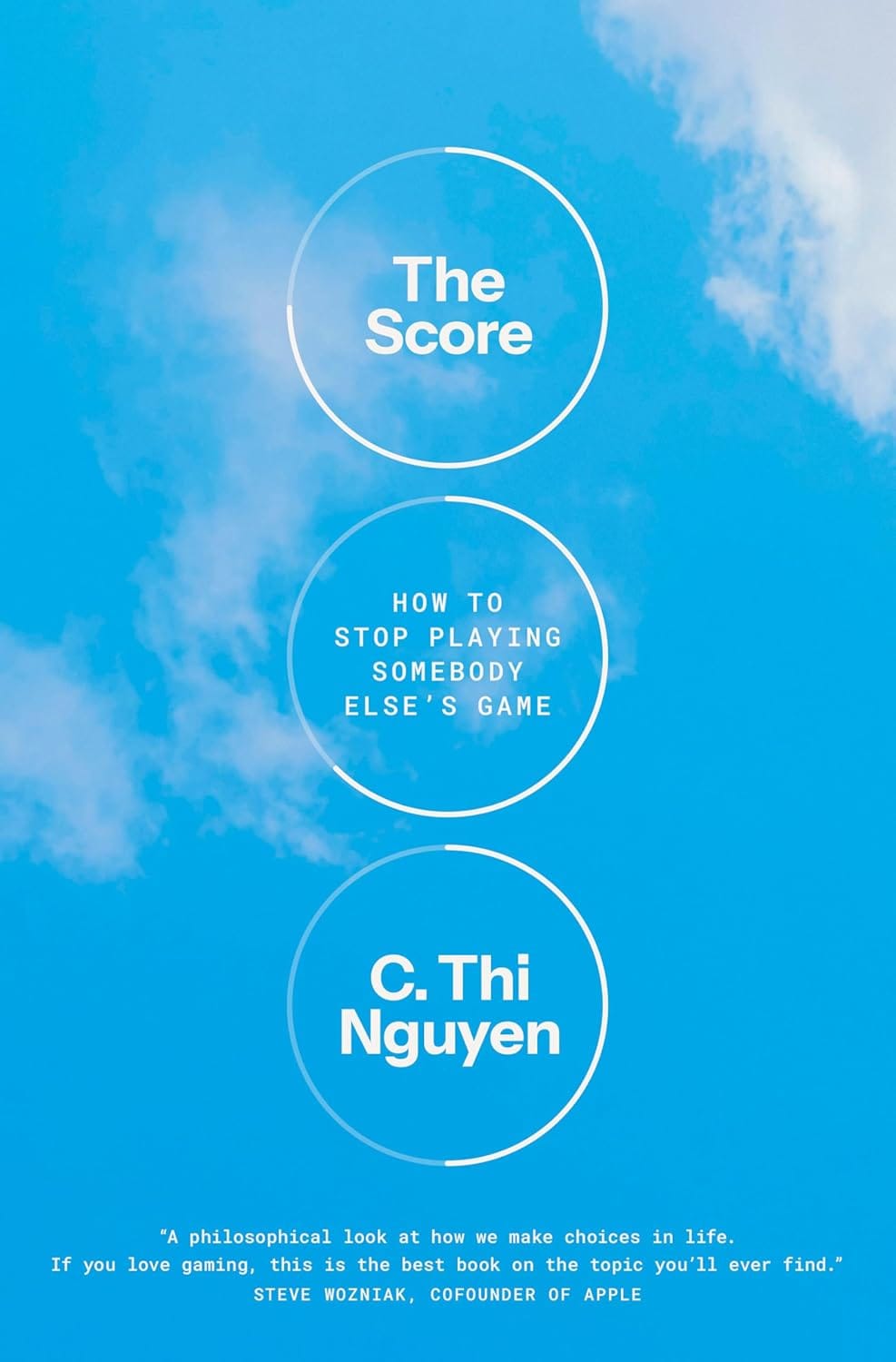
I felt much of the elation and disappointment reading C. Thi Nguyen’s The Score. Nguyen is a philosopher of games, and he wants to interrogate what he seemingly sees as a contradiction: why are we so enthusiastic about playing games with their arbitrary rules when we find the same systems in our workplaces and in our governments abhorrent and alienating? Why is one play and the other is work?
Admittedly, this is a novel frame to me within this literature. I say that mostly because it doesn’t seem to be a question worth asking since the answer seems prima facie obvious. As a comparison, it’s a bit like comparing playing soccer with friends with being forced on a death march in a Japanese prison camp. After all, they’re both exercises that involve using one’s legs. But is it really worth philosophizing such a question?
Well, he wrote the rest of the book, so the answer is apparently yes. In the analytical philosophical tradition, we start with terms and definitions and start building our way forward. Thankfully, Nguyen knows to enliven his text with stylized facts, interesting stories and a nerdy blend of hobbies ranging from rock climbing to yo-yo that together make an otherwise dry subject much more accessible for the general reader. Later in the book when talking about category theory, he writes “I am terrified that in about two seconds, you’re going to put down this book in disgust. But I have become convinced, after beating my head against understanding metrics for years of my life, that this is where the action is.” What is he talking about? “We need to talk about classification manuals.” This is on page 216 — who reads to page 216 and somehow quits right there?
It was joyful to see arcane academic works from a decade ago that were surreptitiously passed around Cambridge suddenly get their shining moments in front of a general purpose reader in what has been a bestseller. It’s great that these works and the ideas they convey are finding a wider audience. Why rankings are so pervasive in society and why they undermine critical thinking (Nguyen calls this “objectivity laundering,” which is a good way to describe it) is valuable. I realize that the revelations of the text would be much more interesting to someone who hasn’t already seen the light.
The book was also great at combining thoughts about quantification with games and philosophy, which is at the heart of Nguyen’s academic work and which the book felt particularly fresh. The idea of the “aesthetic striving player” is useful: “In aesthetic striving play, we control our mechanical scoring system in light of some larger, nonmechanical purpose, like my playing around with my goals in fishing to find which one will give me the most meditative trance.”
Or take rock climbing, one of Nguyen’s recurring examples. No one “wins” rock climbing, but they can get progressively more sophisticated in the sport. That maturation can reduce the emphasis on the particular technical point difficulty of a climb and instead can redirect attention to, say, the flow experience itself (strangely, there’s no mention of Flow by Mihaly Csikszentmihalyi, which has large examples pulled from rock climbing as well and has a number of obvious overlaps).
What Nguyen ends up struggling with — as does the entire field he’s picking from — is the lack of any strategy to thwart the metric-ization of modern life. That’s not specifically his fault, but the lead up of the book will be a let down for most readers. We have come on this journey to learn why we hate metrics, but then, we already hated them before. We asked this big question about play versus work and games versus life, only to end up right where we started from.
Worse, he in some ways seems to fall into quicksand when he starts talking about the dangers of public transparency targeted at institutions. This is a part of the book that I agreed with, in some ways wholeheartedly: evaluating complex behaviors with poor and simple metrics can be worse than not even evaluating an institution at all. But his argument’s weaknesses are apparent: someone, somewhere has the right to evaluate the work of pretty much everyone else. Inevitably, that judgment will have to be simplified. As David Runciman wrote in his own review of The Score:
A points-based system is obviously reductive, but without some easily accessible mode of assessment the insiders will retain their advantage. Nguyen would like to think that those with the inside knowledge of a particular pursuit – philosophy, yo-yo – are the best judges of its true value. But this is not true. They are both the best and the worst judges. That is why they can’t simply be left to choose the game they wish to play.
Doctors are best at evaluating other doctors, but they will also rig the game to avoid the accountability they themselves don’t want to face. Ditto lawyers, government bureaucrats and really any kind of expert. There’s a central tension in democracies about how to handle the non-democratic, elitist experts that society needs to survive. It’s also been written about for decades by the likes of my one-off grad advisor Sheila Jasanoff and others.
Nguyen leaves the reader with a very awkward set of three endings, each of which is about three pages long. One is on BoardGameGeek.com, which he takes to be the best version of the book’s thesis. The site allows users to essentially construct their own rankings, allowing their own taste to dictate the ratings of the games they want to play. Instead of one all-powerful and conforming ranking that reduces human artistry and diversity, there are thousands of rankings that all compete with one another in a very idiosyncratic and nerdy marketplace of ideas.
Then there are two more endings, one dubbed “The Cynical Sad One” and the other “The One with a Little Measure of Hope.” Why they exist, I haven’t a clue. Nguyen writes, “I couldn’t really decide how to end the book, because I’m really of two minds about all this stuff myself. So, in the spirit of games, you get to choose.” At least he’s honest? Of course, the reason I pay $32 for a hardcover is for you, dear author, to tell me what you think. I’ve gone on a 300+ page journey alongside you — give me the final destination. I might vociferously disagree with where you end up, but at least make your closing argument.
It almost felt like he ran out of time to come up with that final statement. Indeed, while the book is fluent and reasonably engaging, it also seems to be written in extreme haste. The word “weird” or “weirdly” shows up probably a dozen times in the text (roughly equivalent to my nervous writing tick of constantly writing “sort of,” which I have now properly deleted three times in this very book review). There are adjectives and adverbs galore that are clearly chosen without thought to their particular meaning, made only more ironic by several sections in the book about the importance of language and control. I am not necessarily asking for a didactic display of precise literary language, but I repeatedly felt that an editor could have helped guide the book’s word choices to a better place.
In the spirit of The Score, I rate it a 7. What’s that out of? You’ll have to decide for yourself.