This week saw several big news stories: the final, final repeal of Net Neutrality, the Time Warner-AT&T merger, the Kim-Trump summit, and the continued ups and downs of President Trump’s trade tariffs and ZTE penalties.
This article went hyper-viral this week. It’s essential argument is that now that ISPs like AT&T and potentially Comcast have bought large content libraries, content companies like Netflix and YouTube (i.e. Alphabet) are going to have to get into the distribution business in order to compete effectively. That doesn’t mean they need to blanket the U.S., but a careful strategy of targeting the most lucrative markets for the biggest carriers could allow them to mitigate the effects of vertical mergers in the industry. Even better, they could work together to break those monopolies. Extensive comments on TechCrunch as well as on HackerNews.
This was an argument regarding the complete redundancy of the modern media. There are literally thousands of journalists who holed up in Singapore in a warehouse this week where they watched the proceedings on television. How many millions of dollars were spent ferrying these folks, and where could that money have been better spent to create differentiated and unique content? Editors still have a lot to learn about the future of media businesses.
This article was a deeper analysis into the current state of the Trump tariffs, NXP-Qualcomm, and ZTE’s fine. This situation has called for a dexterous level of strategy by all players, but ultimately, ZTE has few cards left to play. Congress may
This week, I focused on several major Asia tech and finance stories that will radically reshape the divide between the U.S. and China. Several of these stories have been issues debated for years that are now seeing resolution, such as MSCI’s decision below. It’s a constant reminder in Silicon Valley that despite the region’s power in tech, many others around the world are plotting to compete effectively.
China is launching a new financial vehicle known as Chinese Depository Receipts, which are mirrors of a similar vehicle in the United States known as American Depository Receipts. This mechanism allows local investors to invest in foreign companies, without the logistics of moving money across borders or handling foreign account holdings. In other words, it dramatically expands the pool of capital for companies, which can drive up their valuations. Given that most Chinese tech companies are based outside of mainland China, the CDR mechanism will allow many of them to access mainland investors for the first time.
This was a major story in the U.S./China trade war over the past few weeks. In the end, it looks like the Trump administration voted to merely penalize the company rather than kill it. The sudden shock that the U.S. could just shut down a major Chinese company though is now being called the country’s Sputnik Moment, and has already pushed the CCP to double down on indigenous tech development.
MSCI will include domestic Chinese A-shares for the first time. Given that trillions of dollars are indexed against MSCI’s emerging markets indicators, the decision will likely mean
Ethics is extraordinarily important for journalists, analysts, and researchers. I have posted an ethics statement on this website, so that any conflicts real or perceived can be understood by my readers. It will be updated as needed in the future.
Princeton University
Danny Crichton / April 5th, 2018
Personal Background
Readings
Venture trends from the field
Building a startup today
Agenda
Personal Background
Narcissism
Readings
Essays
Venture Trends
Life in 2018
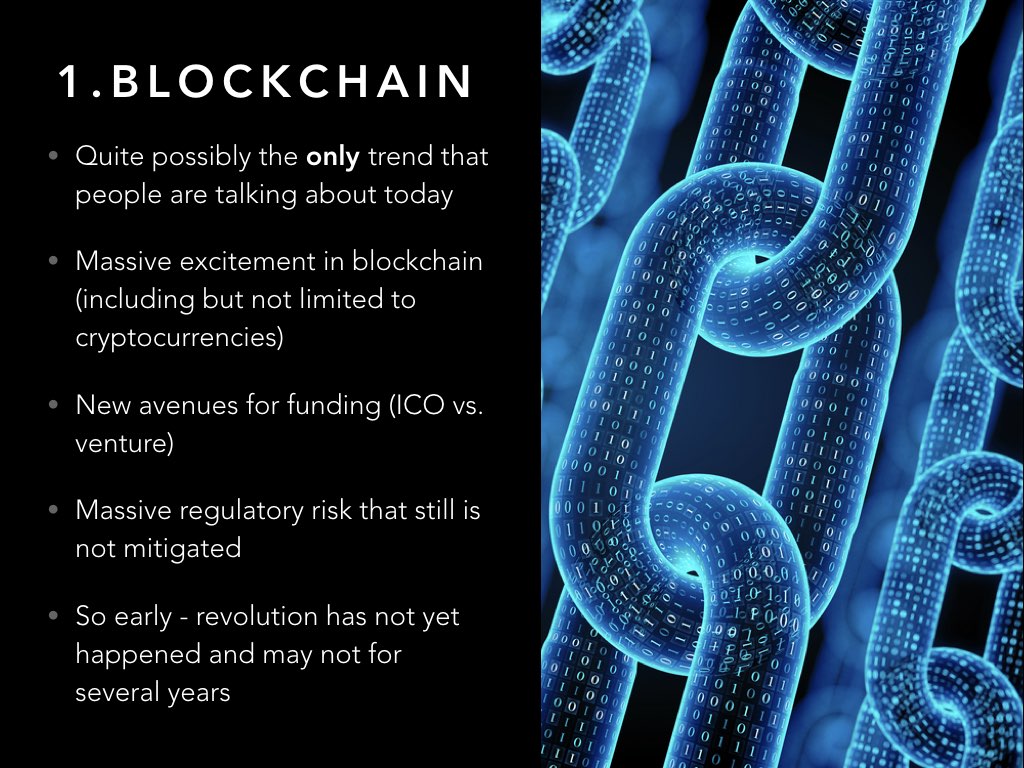
1.Blockchain
Quite possibly the only trend that people are talking about today
Massive excitement in blockchain (including but not limited to cryptocurrencies)
New avenues for funding (ICO vs. venture)
Massive regulatory risk that still is not mitigated
So early - revolution has not yet happened and may not for several years
2. Huge Biotech Excitement
Massive interest in “deep insight bio” - software and bio
Massively increasing valuations
Political pressure and regulatory reform from FDA
Global increase in spend
3. Startup Frontier IS increasingly “complex”
Growing realization that complex ventures are only interesting investment area
GovTech, “smart enterprise”, “emerging tech,” logistics, cybersecurity, and other new investment themes are very popular these days
Problem: partner talent not always matched with themes
4. Asset class arbitrage
SBIR program increasingly used by startups to launch
Early-stage SV VCs are competing ferociously with traditional funders given better economics
Remains to be seen if long-term returns will match today’s enthusiasm
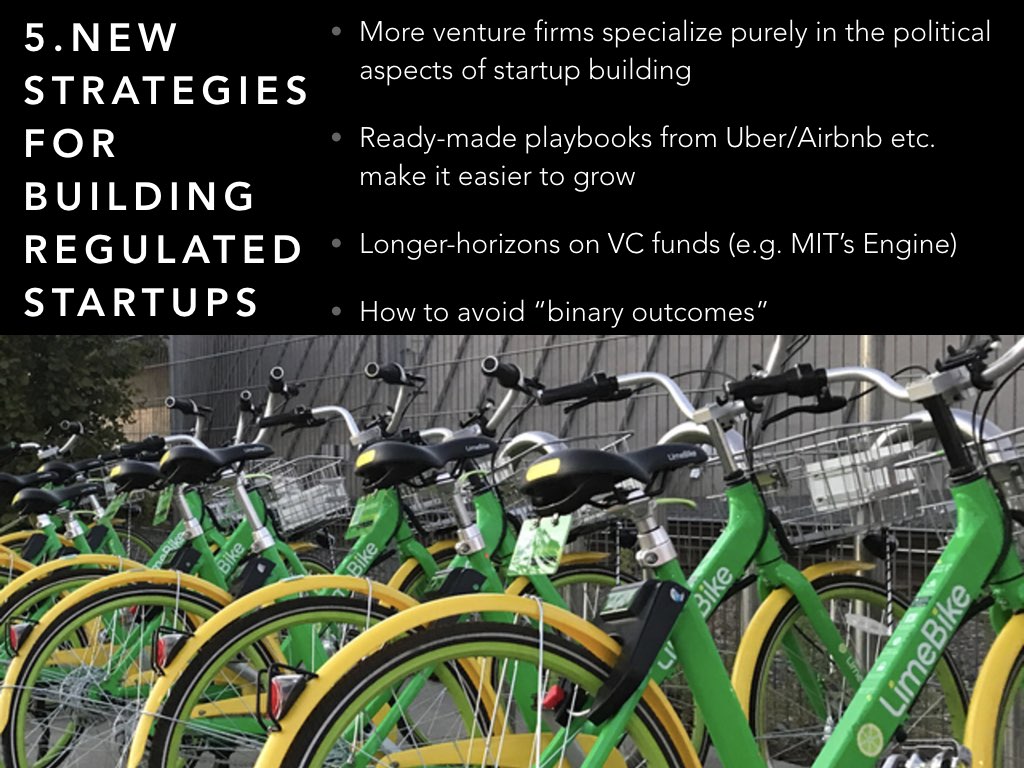
5.New Strategies for building regulated startups
More venture firms specialize purely in the political aspects of startup building
Ready-made playbooks from Uber/Airbnb etc. make it easier to grow
Longer-horizons on VC funds (e.g. MIT’s Engine)
How to avoid “binary outcomes”
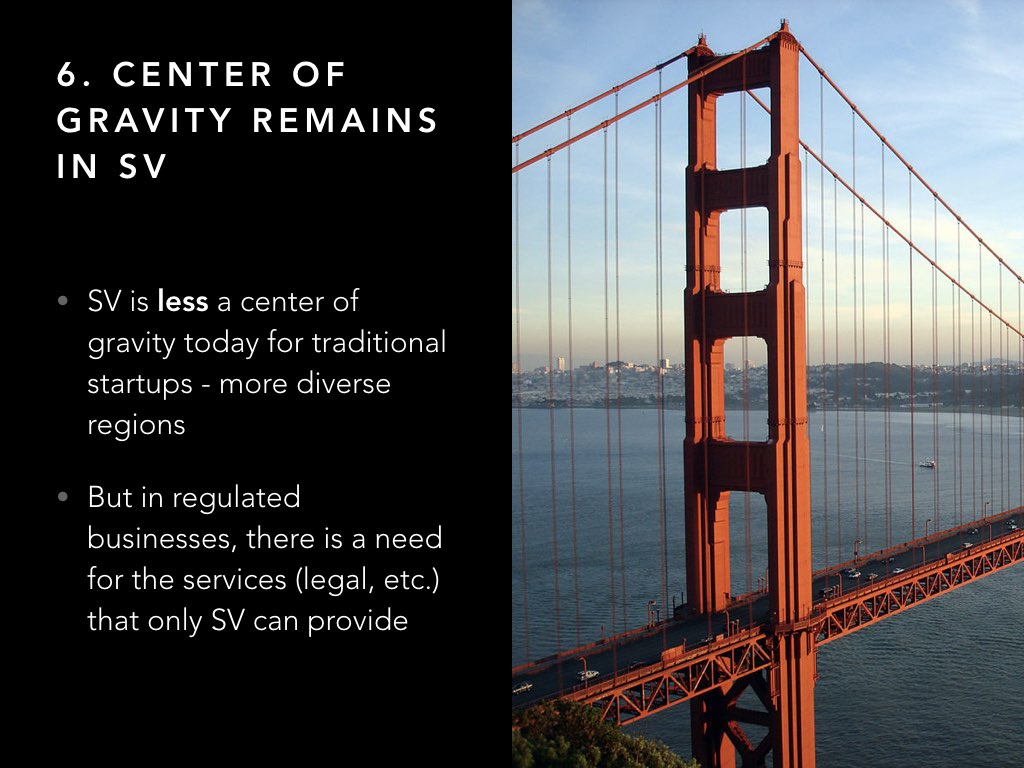
6. Center of gravity remains in SV
SV is less a center of gravity today for traditional startups - more diverse regions
But in regulated businesses, there is a need for the services (legal, etc.) that only SV can provide
Building a Startup Today
Life in 2018
1. Finding a niche Is hard
Unlike consumer apps where “imagination” can take you to your destination,
I have been slowly reading through Katrina by Gary Rivlin. The book, written 10 years after Hurricane Katrina struck New Orleans, analyzes the storm’s aftermath and the process of rebuilding. The politics here are riveting, and it is both heartening and disheartening to see how a city can come together around tragedy — as well as still bitterly fight the “old fights.”
So far though, the bigger lesson to me is how much the media got wrong in the days immediately after the storm — and this is crucial — how much of that coverage later drove decision-making about what to do in the city long-term.
This in some ways is not a revelation — it is hardly surprising that some facts are wrong given how rapid the media covers breaking news events. But I do think we forget in the constant firehose of news and stories from around the web how little permanence any of this news actually has.
Let me take Trump’s election victory as an example. His upset win — against the odds posted by organizations like the New York Times — became instant fodder for reporters and analysts across the political spectrum. We had the theory of the white working class, the Clinton campaign ineptitude logic, the FBI investigation logic, foreign propaganda from Russia, etc. etc.
A year into this administration though, can we say for certainly that this president is going to be a momentary blip in the flow of history, or is he going to be one of the most important presidents and usher in a Trump era of American history (or obviously something in between). Isn’t it nuts that with all of the reporting and discussion emanating from the media the past year, we can’t even really answer this most fundamental of questions.
It’s another year, and another year of great books. One of the goals of this year was to write more reviews of books that I have read — as you can see from the archives, that failed miserably except for a capsule blog post about Cixin Liu’s Three Body Problem. I am making no promises about this next year.
That said, there were a number of great books that I read this year, and I hope more people read them as well. As I wrote about last week, I am attempting to be more deliberate with what I am reading. So there is more fiction this year, and I hope that trend continues next year.
Pachinko by Min Jin Lee
This was the single best book I read this year. First and foremost, it is an amazing novel about the challenges of a family on the edge of society trying to make it between two cultures, Korea and Japan. But at its heart, it is a meditation on the challenges each of us face as we are confronted with events far beyond our control.
Pachinko is a Japanese parlor game that’s sort of a more gambling-oriented pinball (Google for more careful discussion of the importance of the game to Japanese culture). While the operator has some control over the balls in the game, ultimately, those balls are going to bounce against obstacles, mostly on their own, and winning or losing the game has more to do with the odds of the parlor than any specific actions on the part of the player. Yet, the feeling of skill — of control — is critical to the belief that we have agency in a harsh world.
Lee managed to layer that high-level metaphor into the family at the heart of
I have two problems: one is that I read a lot of books. The other is that I buy a lot of books. Unfortunately, my credit card is more plentiful than my time these days, which means that I have an increasingly large number of books that I haven’t read yet. I even bought a separate bookcase in order to hold all of these volumes. I currently have approximately 300 books in my apartment, and about 20% of those are unread.
I read a post (which I have since lost) which said that the basic rule of books is that if you bought a book and haven’t read it within a decade, you probably should just find a way to give it away. Books should fundamentally be exciting — they transport us to strange new places and can show us both the past and the future. There is a tragedy when books become burdens — reminders of all the interests and wonder we once held and no longer have time for.
And we really don’t have time for so many works. Every year, there are millions of books published if we count self-published as well as traditional publishers. Indeed, there has been a veritable explosion of books published in the last few years. Even when we filter for quality, the deluge is just extreme. I once tried to only buy books that were rated five stars on Amazon: and my wish list still kept growing. Seriously, try just to keep up with the top prize winners every year — you are still going to get 10,000 pages of content per year.
I think there are two sides to this. One is that I am addicted to reading, and I am weaning myself off of it. That might sound
Key point of piece : With signals of authority and tone erased from our information environment, we have a wide, systemic crisis in news . pic.twitter.com/TfC9p0FafL
This is an apt description of the problem of modern “content.” Journalists are now lined up next to native advertising partners. Ads often take on more signals of authority than researched pieces. We once were able to distinguish between all of this, but as we have blurred the lines, we have empowered those who want to bamboozle us (Russia?) while disempowering our most thoughtful writers and researchers.
While a lot of the focus in the media the past few months has been around Facebook, Twitter, Google, and other tech giants, I think the real fault lies in ourselves. We are the ones who don’t seek out high-quality information, or ensure that the content we read isn’t garbage. We are the ones who blindly read native advertising even though our tingling truth filter is letting us know that we are being led on. Sure, the internet has made it harder to know who is smart and who is secretly a dog on the Internet, but it isn’t that hard to verify this stuff.
Here are the strategies to inoculate against bad content:
Stop reading brainjunk - always run through a loop before clicking a link and reading an article. Is this publication legitimate? Who is the author? What is their background on the topic? Do they seem to have the right qualifications to write this article? Have they written something before? Avoid unsigned articles — everything is written by someone, and there is no good reason why you shouldn’t know who that someone is. Also
Hi, I'm Danny. I'm Partner, Research at VC firm Lux Capital, where I publish the Securities newsletter and Riskgaming. I'm also a Fellow at the Manhattan Institute in New York.
Formerly, I was managing editor at TechCrunch and a venture capitalist at Charles River Ventures and General Catalyst.