I was having two separate conversations with my friends this week, and both were complaining about recent challenges around promotions, In both cases, their managers had assured them that a promotion was in the offing, and that it was merely “paperwork” that remained before it would be processed. In both cases, promotions were delayed for these employees, engendering cynicism in an otherwise productive relationship.
Another friend of mine recently discovered that he was being paid significantly lower than other people at the same firm with the same experience and job title. Not a small pay difference, but something on the order of 40-50% of salary. When he checked around with colleagues, it seemed that others had worked harder to negotiate better bonus structures over the years, since their base salary rate was roughly the same. Since he hadn’t re-negotiated in three years, his salary had fallen massively behind.
In all three of these cases, people were good workers, but terrible communication from their respective companies has massively diminished their enthusiasm for continuing their careers. In fact, all three emphasized the need to move on to other firms, since it seemed that the best way to move forward in their careers would be to negotiate their salary with a new company. What a loss for their current employers, who will see valuable talent walk right out the door.
There is a bit of a zero-sum conversation that happens around promotions and salaries — companies can promote this person or this person, or raise one salary and keep the other level (to maintain the same budget). We rarely get out of this box to ask why we are having this conversation in the first place.
Two thoughts come to mind here. The first is that there needs to be
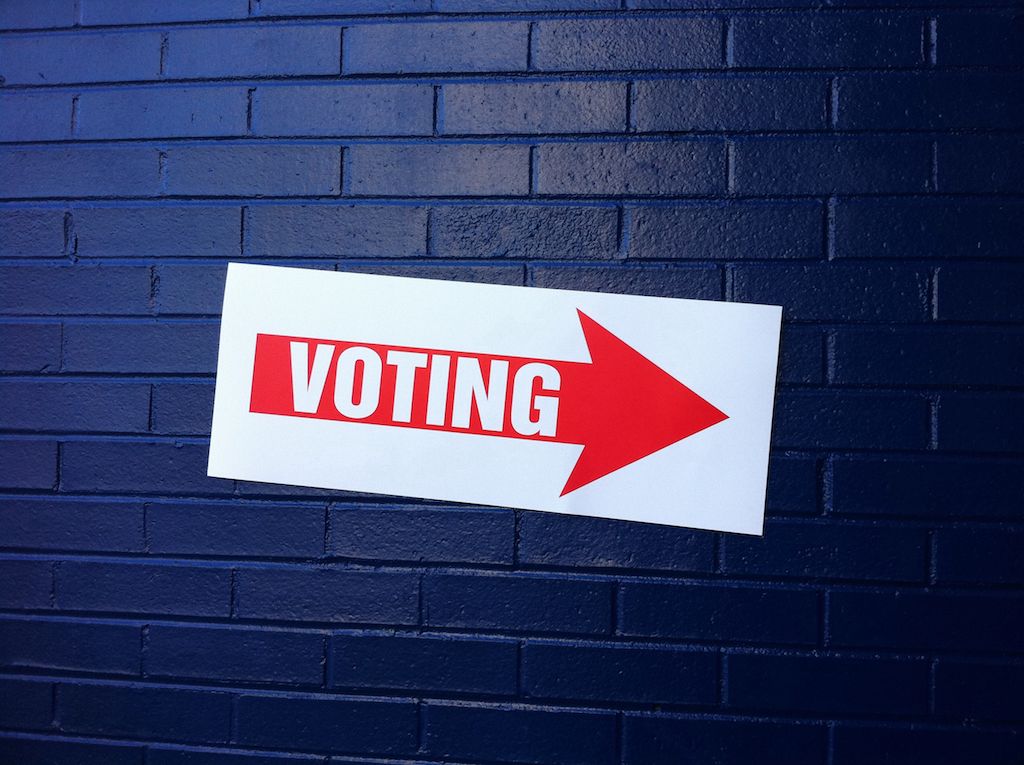
That’s the question that will be on every ballot in a week’s time in New York.
Every twenty years, NY voters have the opportunity to vote on holding a constitutional convention. If a majority of voters vote yes, each state senate district will elect three delegates to the constitutional convention (in addition, several are nominated to represent state-wide interests). The delegates will hash out changes — anything from a few words added, removed or updated all the way to a full re-write of the entire document. Those changes are then brought before voters again at the ballot box, and if a majority support it, those changes are ratified.
While California ballot propositions technically could do something like this, it’s rare to have the opportunity to hold a convention and take a holistic approach to updating the constitution of a state for the 21st century.
Given the process, I am strongly in favor of holding a convention.
I think one of the real challenges of politics in 2017 is the lack of interest in making transformational changes that dramatically improves the lives of Americans. Our ambitions as a nation are constantly getting crushed by small considerations at the expense of the big picture. Whether it is transportation, or housing, or health care or any number of other policy areas, we just no longer think big.
That’s certainly how local politicians see it. The ballot question is one of the stranger politics in New York. Unions are uniformly opposed to holding a convention — there are palpable concerns that are probably justified that the text of an updated constitution might provide the state with ways to avoid its extraordinary pension obligations.
Likewise, there are many politicians on the right who are opposed, because they fear the constitutional convention
Princeton University EGR 475
Danny Crichton / Oct 20th, 2017
Personal Background
Venture trends from the field
Building a startup today
Agenda
Personal Background
Narcissism
Complex Venture Trends
Life in 2017
1. Huge Biotech Excitement
Massive interest in “deep insight bio” - software and bio
Massively increasing valuations
Political pressure and regulatory reform from FDA
Global increase in spend
2. Startup Frontier IS increasingly “complex”
Growing realization that complex ventures are only interesting investment area
GovTech, “smart enterprise”, “emerging tech,” logistics, cybersecurity, and other new investment themes are very popular these days
Problem: partner talent not always matched with themes
3. Asset class arbitrage
SBIR program increasingly used by startups to launch
Early-stage SV VCs are competing ferociously with traditional funders given better economics
Remains to be seen if long-term returns will match today’s enthusiasm
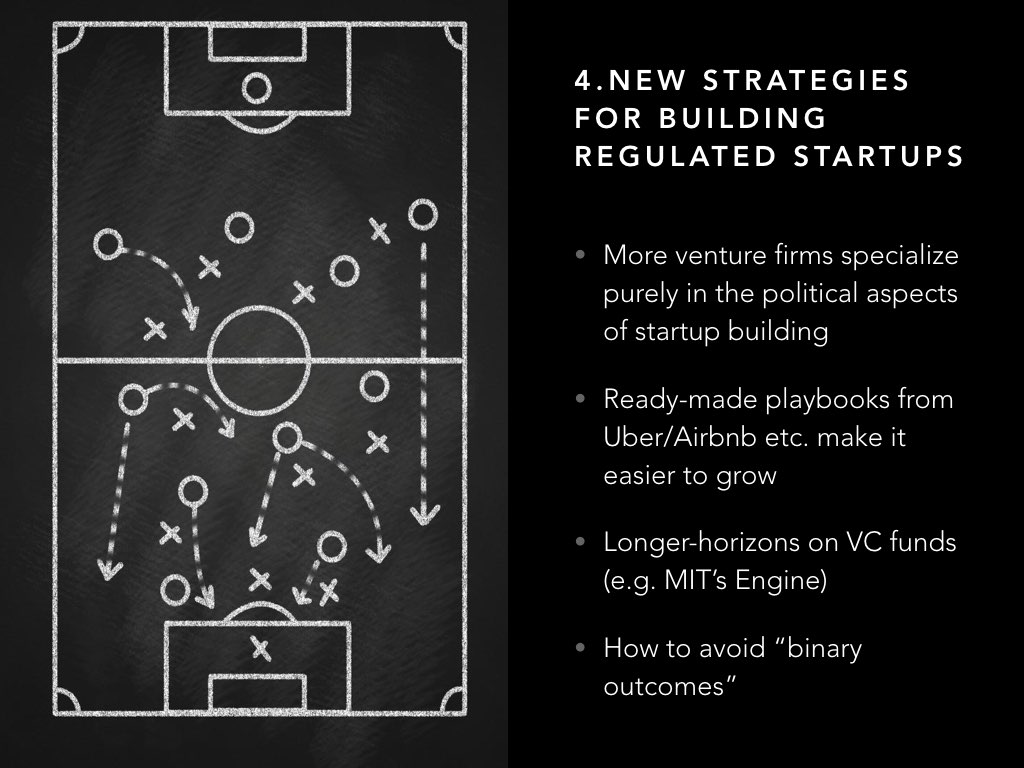
4.New Strategies for building regulated startups
More venture firms specialize purely in the political aspects of startup building
Ready-made playbooks from Uber/Airbnb etc. make it easier to grow
Longer-horizons on VC funds (e.g. MIT’s Engine)
How to avoid “binary outcomes”
5. Center of gravity remains in SV
SV is less a center of gravity today for traditional startups - more diverse regions
But in regulated businesses, there is a need for the services (legal, etc.) that only SV can provide
Building a Startup Today
Life in 2017
1. Finding a niche Is hard
Unlike consumer apps where “imagination” can take you to your destination, regulated startups require a lot of strategy up front
Learn from a wide variety of professionals and sources
2. Product Design is really hard
Product design is much more challenging with regulated businesses - in some cases, pre-approval before you can even use in the field
Find feedback loops early
Two stories collided for me this weekend. The first was from Austria, where 31-year old Sebastian Kurz led his People’s Party to an electoral victory, driving that country harder to the right. Kurz was formerly the foreign minister of the country, a job he began at the advanced age of 27 years old. Assuming that negotiations with his coalition partners don’t upset the process, he will become the youngest sitting head of government in Europe.
Interestingly, this somewhat matches the meteoric rise of Emmanuel Macron in France, who assumed the presidency at 39 years old. While two countries is hardly statistical valid evidence, it is striking that Europe seems to be priming a new generation of politicians for leadership.
Meanwhile, in the United States, the other story this weekend that caught my eye was from New York, where Ginia Bellafonte asked in The New York Timeswhy so few young people seem to run for local politics. Quoting from the article:
New York City may be more lamentably dull than it was 20 years ago, but it remains a magnet for exceptional talent — in many parts of Brooklyn it is easier to trip over Rhodes scholars than it is to find a half-gallon of milk with additives. Recent economic studies also suggest that as knowledge fields have become increasingly concentrated in the country’s biggest cities, New York has become even more attractive to the brilliant and prestigiously educated.
That from this vast pool we have not been able to fish out a vibrant, impressive (and young) political class is one of the paradoxes of life in New York right now.
Indeed.
New York may be a special case of course (Stockton, CA, a city of about 300,000, is headed up by 27-year-old
Like many people, I continue to look at the devastation in Puerto Rico, California, Houston and Miami with a mix of shock, horror, and resignation. Twelve years after Hurricane Katrina struck New Orleans and the Gulf Coast, it seems that we have barely made any progress on how to respond to disasters in a timely fashion.
Why?
An initial challenge that I think goes overlooked is that it is really hard to quantify disaster recovery. Sure, Puerto Rico’s government has put together a nice dashboard with their progress, but what exactly are we comparing it to? What’s the benchmark? 15% of households currently have power in Puerto Rico — is that good or bad? Maybe the federal government is doing a fantastic job bringing back power for any households given the devastation …. Or maybe the federal government is doing terribly, and should be at say 40% if they were competent. It’s really hard to say because we are comparing to a counterfactual.
The second challenge, and one that is only going to get worse, is that these disasters are getting more intense over time. One part if this is certainly that storms are getting more intense as climate change rears its ugly head. But that’s not all: urbanization is increasingly pushing people to live in areas that are not resilient for disasters. Houston, for instance, might have had significantly less damage if homeowners didn’t literally live in a designated flood zone.
Disaster Recovery starts with Disaster Preparation, and so when we get to the root of the challenge, we see that it isn’t just FEMA lacking generators or the president shooting hoops with a roll of paper towels. It’s that the very architecture of urban life is ill-suited to the chaotic world that
In Bannon’s view, China is harming the U.S. by engaging in unfair trade practices, such as the forced transfer of U.S. technology to Chinese companies. While many experts agree, Bannon has a more dire view of the consequences. “There have been 4,000 years of Chinese diplomatic history, all centered on ‘barbarian management,’ minus the last 150 years,” he says. China’s historical disposition toward trading partners, he contends, is exploitative and potentially ruinous. “It’s always about making the barbarians a tributary state,” he says. “Our tribute to China is our technology—that’s what it takes to enter their market, and [they’ve taken] $3.5 trillion worth over the last 10 years. We have to give them the basic essence of American capitalism: our innovation.”
Bannon’s analysis of Chinese history may be glib, but his points about technology transfer are not. China — more than any other country — has built an economic apparatus designed to outright steal American intellectual property, and American politicians have been asleep at the wheel for decades in confronting this problem.
This “learning model” of state economic development is hardly novel. Korea and Taiwan are perhaps the greatest users of this strategy in the twentieth century, having constructed an industrial policy focused on science and technology learning that allowed those two countries to become electronics powerhouses. Their rise was not inevitable, but rather the deliberate work of government and business leaders.
China has in many ways copied this playbook, updating it for the internet age. Where before you had import substitution of goods, now China effectively uses the Great Firewall to
For those who have been paying attention to the press this past week, there have been two interesting independence movements, both involving breakaway provinces from strong U.S. allies. In Spain, Catalonia staged a vote this weekend, and in the northern reaches of Iraq, the Kurds held a vote earlier this week. In both cases, the central governments worked feverishly to annihilate the vote, and are now working overdrive to undermine their legitimacy post-ballot.
I get why central governments want their nations to remain whole, so it hardly surprises me that Spain and Iraq are using such aggressive tactics to squelch these movements. What is more surprising to me (or depressing depending on how you look at it) is how strongly the U.S. is also opposed to these movements, particularly given our own history of separating from a central authority.
I get that there are very challenging politics, particularly in regards to Iraq. We need their support in the war against ISIS, to stop Iran, to provide some stability in the region among many, many more reasons. That’s completely legitimate reasoning. But to my mind, there has been far too little action on our part to actually promote self-determination to more people around the world, at a time when democracy has been in retreat around the globe.
Some more political fragmentation is actually a good thing, particularly when a group of people with a shared culture, history, and language are starting to demand accountability to themselves for building their own prosperous future. If people are willing and able to take on the risks of being their own political power, I don’t see a reason why we should be reflexively opposed to that.
Much like my thinking around Brexit, I think it is also worth asking
I just finished Cixin Liu’s Three Body Problem, the winner of the Hugo Prize in 2015. Liu is one of the most popular and prolific authors of science fiction in China, and this book is one of the first of his works to be translated into English.
I will try to avoid spoilers, since mystery is really one of the driving plot points of the novel.
Liu addresses a variety of themes, although thankfully never meditates too long on any one of them. Perhaps the structural theme of the novel is the juxtaposition of the micro versus the macro. The novel begins with vignettes from the Cultural Revolution involving one of the main characters, Ye Wenjie. We witness Ye’s struggle with the chaos of that conflict in just the first few pages, seeing clearly how small yet brutal our politics can become.
Ye is also an astrophysicist though, and so even though she has faced these horrific challenges very early in her life, she also works with the stars and the wider question of what humanity’s place is in the cosmos. This theme plays out across the novel, and Liu carefully expands our field of vision so that the politics of the Cultural Revolution seem distant, albeit still echo in our minds. That transition is really quite brilliantly done, and represents the craft of science fiction at its absolute best.
Liu is known as a more “hard” science fiction writer, and there is definitely detailed discussions of mathematical theories and fundamental physics that certainly has the feel of a Neal Stephenson novel (albeit with better editing). Those theories play a pivotal role in the plot, and so it is nice to see this sort of deep science research that isn’t just for flavor but actually provides
Hi, I'm Danny. I'm Partner, Research at VC firm Lux Capital, where I publish the Securities newsletter and Riskgaming. I'm also a Fellow at the Manhattan Institute in New York.
Formerly, I was managing editor at TechCrunch and a venture capitalist at Charles River Ventures and General Catalyst.