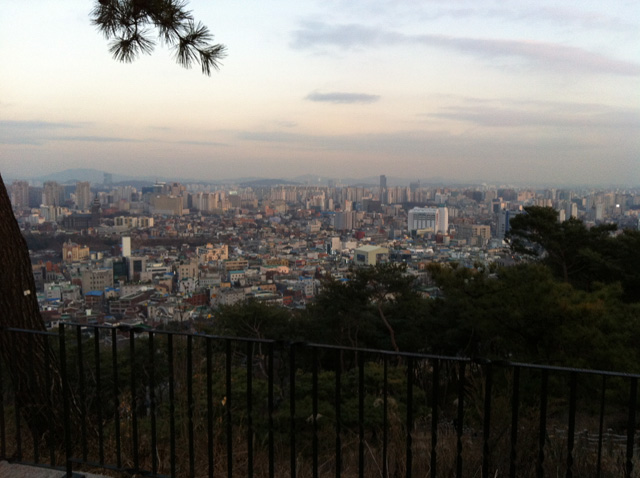
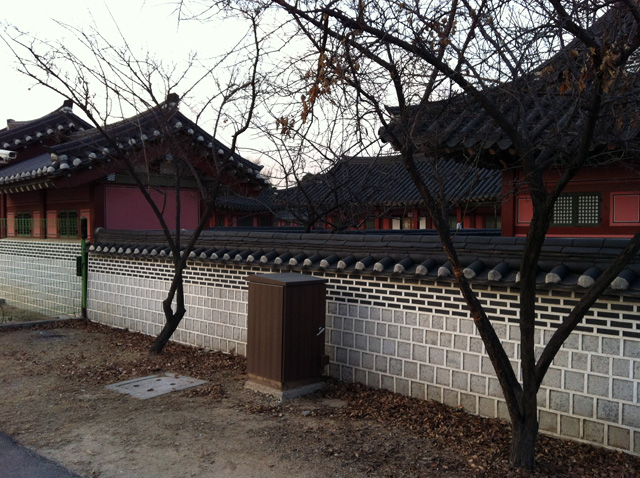
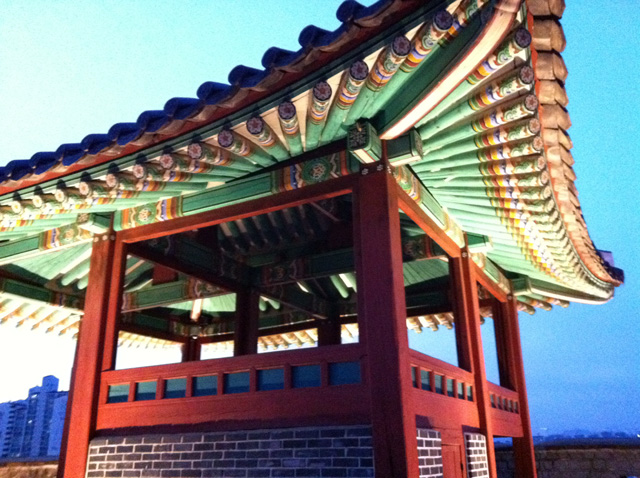
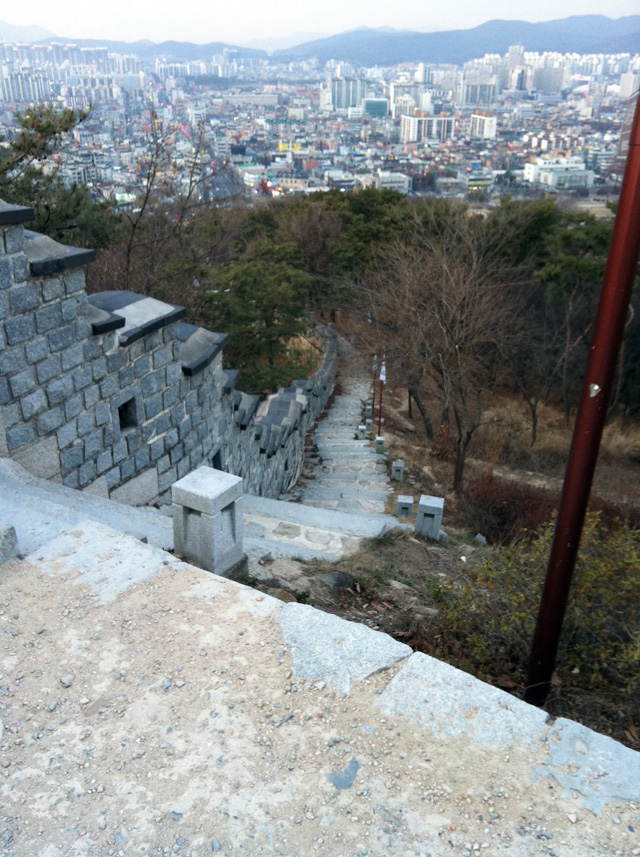
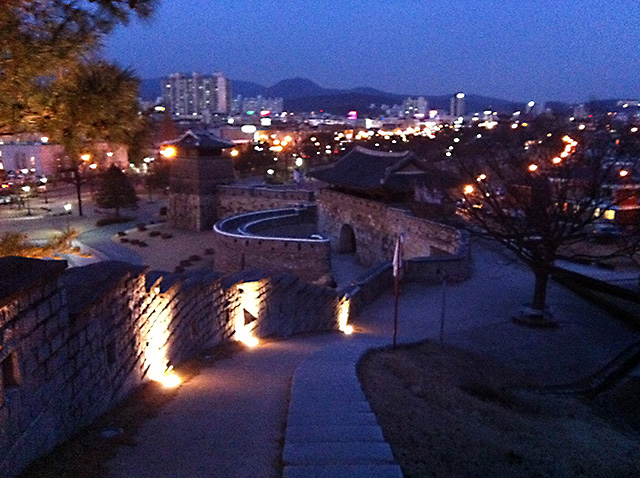
A few weeks ago, I visited Suwon, a fairly large city just to the south of Seoul. The city is famous for Hwaseong Fortress, a castle from the Joseon Dynasty that is today designated as a UNESCO World Heritage Site. Suwon is the only enclosed city in Korea, and the walls of the fortress remain quite visible.
Part of the fortress sits on top of a small mountain, providing a panoramic view of SuwonThe Fortress itself is quite extensive, providing facilities for the royals of the Joseon DynastyThe gorgeous colors of the architecture mix well with duskA section of the wall that encloses Suwon (daytime)A section of the wall that encloses Suwon (nighttime)➜ Continue reading...
Yet, there is something still missing from this discussion. Why is it that Android still seems laggy after years of development? This is not a minor discussion, but goes directly to the quality of the user experience of the device. Dianne's main argument (she has several of them) is that Android's API model ensures that every app is sandboxed, and that the ability to optimize the graphics is difficult because the hardware is just not there.
I don't buy that argument.
Instead, I think she nibbles on the right argument near the end of her piece. In the penultimate paragraph, she describes the similar experience between programming for iOS and programming for Android:
One final thought. I saw an interesting comment from Brent Royal-Gordon on what developers sometimes need to do to achieve 60fps scrolling in iOS lists: "Getting it up to sixty is more difficult-you may have to simplify the cell's view hierarchy, or delay adding some of the content, or remove text formatting that would otherwise require a more expensive text rendering API, or even rip the subviews out of the cell altogether and draw everything by hand."
**There is a more fundamental reason why Android is laggy compared to iOS: culture and tools. **The iOS development culture is built around cool design. The Wow Factor is
Democracy is supposed to provide a means of aggregating diverse views into a coherent, consistent outcome. However, what happens when activists, interest groups, special interests, and other organizations start to understand the policy process so well that government screeches to a standstill? Today, almost every political decision is blasted by some group - making it literally impossible to actually govern.
The remarkably rapid progress of the tax revisions - without a public hearing or town-hall-style meeting - provided the most striking illustration to date of Mr. Cuomo's policymaking strategy: information is tightly controlled, negotiations are carried out behind closed doors and the debate is limited to just a few people.
The tactics, derided by government watchdog groups and some lawmakers, have proved highly effective during Mr. Cuomo's first year in office, as he has pushed, against long odds, to win passage of same-sex marriage, a property tax cap, a reworking of ethics rules and extensive budget cuts. And his efforts appeared likely to be rewarded again this week: The Senate approved the tax code changes on Wednesday night, and the Assembly was poised to follow suit.
While derided as anti-democratic, these sorts of tactics are beyond necessary in a media and political system that emphasizes outrage and focuses on the extreme. Ideally, we elect politicians to solve society's pressing problems through an open and fair process, where every citizen has the right to provide input and shape the final decision. Realistically though, open and transparent government rarely provides the environment needed for politicians to actually do their jobs.
This is one of modern laws of democratic politics: transparency prevents things from happening. If you want to shut down public schools, ensure that the data from
The issue of free trade is a contentious one in Korea. The passage this past week of the US-Korean Free Trade Agreement (FTA) was a win for the sitting presidential administration and the conservative Grand National Party, but led to much anger on the left. That anger became quite palpable in the final moments of the vote in the National Assembly when an opposition lawmaker threw a tear gas canister in the chamber, forcing lawmakers to flee.
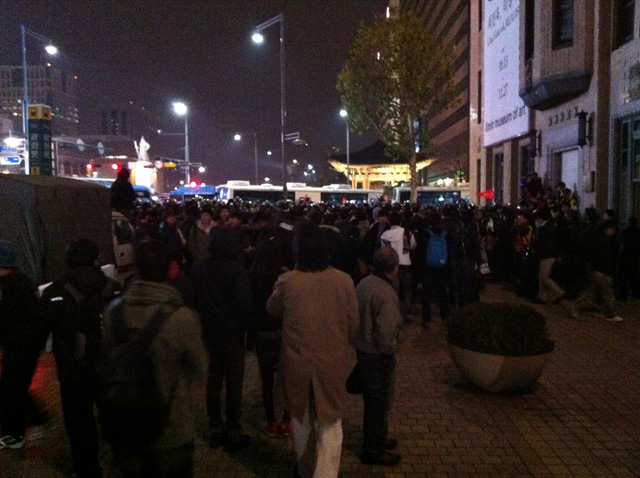
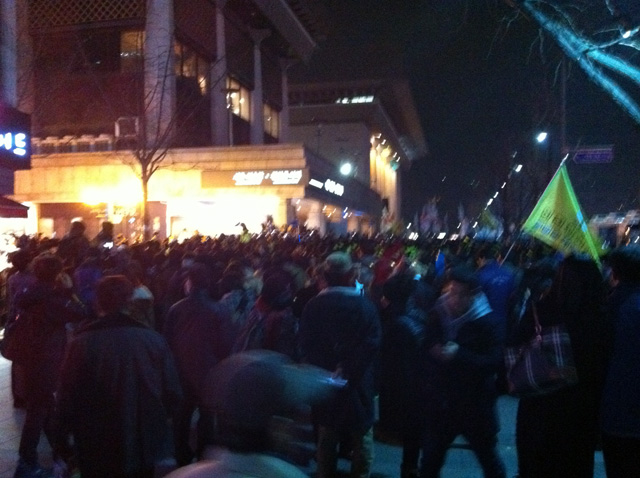
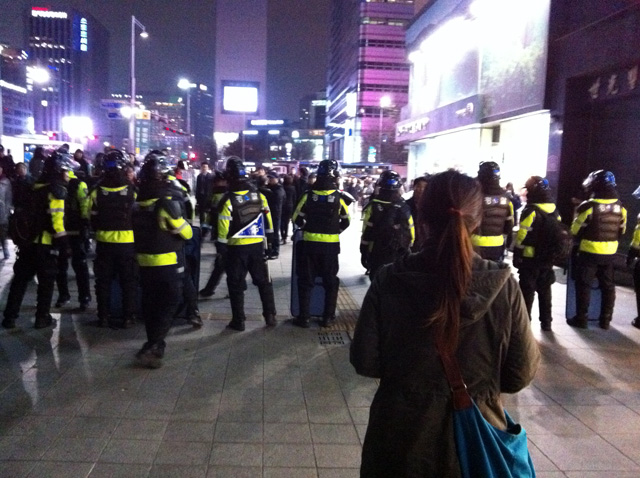
Protests in Korea are a relatively common occurrence, and have been known to become quite unruly. Partly for this reason as well as other historical reasons, they are required to be registered with the government ahead of time. Protests related to imports of beef from the United States drew hundreds of thousands if not millions of protesters in Korea, and the verve of the organizing groups has not slowed down. The protest I observed in Kwanghuamun this past week were relatively peaceful when I was there, although later that night almost 50 police officers were in the hospital, having suffered injuries while trying to disperse the protesters. An unknown number of protesters were injured as well.
An angry crowd attacks police for blocking disabled access points to KwanghuamunA public lecture discusses the potential damage of the FTA treaty.The main protest crowd reassembled near shops after being blocked entrance to the main squareDozens of police buses brought thousands of police officers to maintain orderPolice squads work their way through the crowdsPolice blocked entrance to the protest site (and also prevented people from leaving - including me for a time)➜ Continue reading...
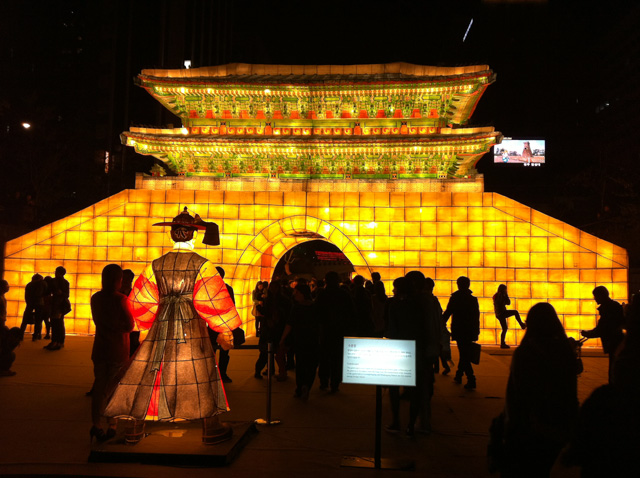
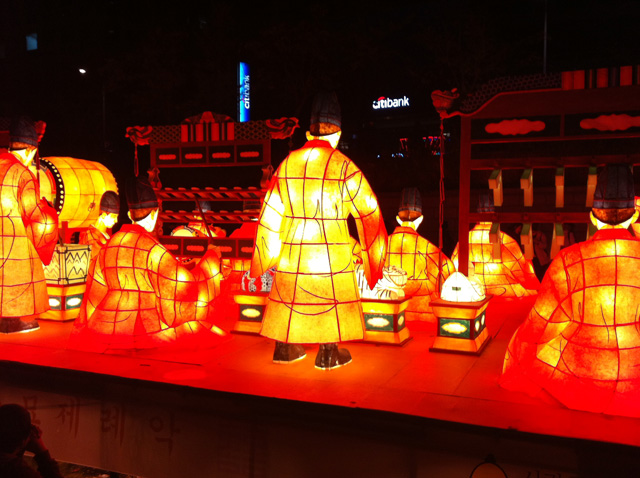
Normally when I write these Image of the Week posts, I include some snarky comments about random things I have seen/taken photos of in Korea. This week, in unusual form, I am going to avoid making any comments on these wonderful photos from the Seoul Lantern Festival. The Lantern Festival has been around for a few years (supposedly 4, although I can't verify that), and each year has increased in status, length, and sophistication. I have to say, this is one of the best public art displays I have ever seen, and I am glad that I accidentally stumbled upon it.
This article by New York Magazine has a relatively even-handed narrative of the man that is increasingly appearing to be the Republican candidate for President this year. Mitt Romney has an incredibly strong business background, and has truly reshaped the nature of modern American business practices.
It is the conclusion of his personality that bothers me:
It is arresting to imagine a Romney White House, inevitably filled with as many former Bain colleagues as each of his other public ventures have been: The PowerPoints, the 80-20 jargon, the clinical separation of decision-making from ideology, the detachment of those decisions from moral consequence, a persistent blind spot for people as people. It would represent the final ascension of a perfectly American type, one that has already remade the culture of business. I once asked a Bain colleague of Romney's how Romney thought of his own core competence. "I think Mitt thinks he's good at being Mitt Romney," the colleague said.
...
Perhaps it is not surprising, then, that he has adopted a public persona that contains no detectable motives at all, one that is buried in objectivity, in data, in process. The best evidence of how important Romney's religion is to him could be how far he has kept it from view. But the character that remains visible is at once uniquely American and a little strange: a perfectly objective efficiency machine.
I just spent the past few days reading The Best and the Brightest by David Halberstam. In it, Halberstam describes the decision-makers behind the Vietnam War, carefully and extensively profiling every senior member of the Kennedy and Johnson administrations. No one played as large and overarching a role as Secretary of Defense Robert McNamara - business giant (former president of Ford) and
KAIST (which, like the SAT, officially means nothing, but at one point meant the Korea Advanced Institute of Science and Technology) was originally proposed as part of a US Agency for International Development mission back in 1970. That committee was chaired by Frederick Terman, Stanford's former provost and the "father" of Silicon Valley. It was charged with developing a plan for creating a university-industry hub that would spur Korea's knowledge industries and assist the country in its economic development plan.
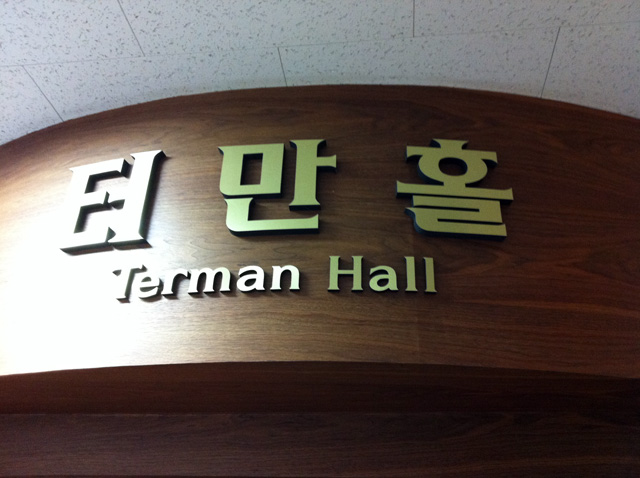
For those interested, the full report has been posted by Robert Laughlin, a professor of physics at Stanford and a former president of KAIST. Below, you can see part of the influence on Terman on the school in the form of the lecture hall named in his honor. (Rumor has it that there is a statue of him on campus, but alas, I have not yet found it despite repeated attempts to do so).
Teryn Norris and Eli Pollak have written a strongly-worded editorial today in the Stanford Daily blasting the finance industry's recruitment of top students. To quote:
Why are graduates flocking to Wall Street? Beyond the simple allure of high salaries, investment banks and hedge funds have designed an aggressive, sophisticated and well-funded recruitment system, which often takes advantage of student's job insecurity. Moreover, elite university culture somehow still upholds finance as a "prestigious" and "savvy" career track.
Their solution is to encourage more students to pursue "socially productive careers in public service, entrepreneurship and scientific research." They also want universities like Stanford to develop systems to encourage interest in these "alternative career tracks."
I wish it were that easy.
I've analyzed the problem before, but I have since gone through the recruiting process myself, which included some of America's top banks. I would like to discuss the difference in recruitment between Bain & Company and the U.S. Foreign Service. I realize Bain is not an investment bank, but its recruitment strategy is for all intents and purposes the same as that of other management consulting firms and investment banks and provides a useful vignette.
Bain visited the Stanford campus early in the year to present their company's pitch, offering a selection of nice snack foods and networking opportunities with maybe two dozen of their consultants. Those interested in applying dropped a cover letter, transcript and a resume into Stanford's online career system, and decisions on interviews came back a week or two later. Interviews were held on campus for the first few rounds, and second-round interviews were held in the office you applied to (in my case, Palo Alto, located about 1.5
Hi, I'm Danny. I'm Partner, Research at VC firm Lux Capital, where I publish the Securities newsletter and Riskgaming. I'm also a Fellow at the Manhattan Institute in New York.
Formerly, I was managing editor at TechCrunch and a venture capitalist at Charles River Ventures and General Catalyst.