I hate binary classifications as much as the next person, but here's one I thought about this morning while talking with a local human resources startup about how HR products should be built today:
Are you empowering the assholes in an organization, or are you empowering the workers in an organization?
What amazes me is how many startups in the HR space sell into the "asshole market" (usually under the guise of "performance management").
We have all heard about and seen awful management. These are the managers that have no trust in their direct reports, need everything verified, and change goal posts whenever events change. They are, in short, just crummy people to work with. Employees often respond to this environment by becoming political -- they attempt to hide information in order to create space between themselves and management to actually do their jobs.
There are two directions an organization can take when it reaches this stage. One is to become less political by increasing trust between employees and empowering them to do their jobs effectively. The other is to try to create panopticon services that allow managers to peer into every single action an employee takes, empowering management to constantly harass workers rather than assisting them.
As I say often, data is fundamentally political. It is easy to think that just providing more data to more people will make an organization work more effectively. This is often false, because it really depends on culture. How will the data be used? If my manager is tracking my every movement by the minute, I am not going to act normally, nor will I do my job very effectively. This is doubly true if they are walking over to my desk every five minutes yelling "why didn't
So, it has been a month since I last wrote a post here. The lack of posts is not a function of time, but rather of friction. Along the way, I learned a valuable lesson in product design that I think might be helpful to others.
For the past few years, I have used a static site generator called Pelican as the main way to update this blog. The concept behind these generators is simple: get rid of all the bloat that comes with a typical Content Management System like WordPress and replace it with simple scripts that generate raw HTML files. The idea is that it is much more efficient to serve simple HTML pages, which is ultimately what blogs are about.
Or so I thought.
The adage of static site generation is that you might update a blog once a day or even once per week, but the blog is downloaded from dozens to millions of times per week. So, it would seem to make sense to optimize the experience for the reader, since ultimately that is the action that happens most frequently.
That optimization though is completely incorrect, because the only reason those readers want to visit a blog is for new posts. Therefore, the only optimization that should take place should focus on making the writing experience as easy as possible for the writer.
Even with some additional scripts that I wrote to make Pelican more palatable, the reality is that it was a real pain to actually write. I had to fix the filename perfectly so that Pelican would read it, I had to run the pelican command line through a script I wrote, then I had to sync all the files to my server so that it could actually be viewed. Whenever I was
Life is often described as a road, a journey through experiences and temporary destinations that we hope will one day sum to something more coherent.
Overused as it is, there is something soothing about this metaphor. Roads don't just sprout up in the wilderness, but instead require deliberate technical planning and intelligence. We are constantly confronted with randomness in our lives, and there is comfort in the feeling that this "road" is part of a grand design by some higher transit engineer who is carefully tending to our journey -- laying out the macadam before us so we never lose our life's destiny.
This transit metaphor has always bothered me, though. No engineer would willfully build the route that many of our lives have taken. There are so few straight courses -- so few highways –– that one begins to think that the road was purposely built just to be frustrating to travel. The destination of our life’s journey may be only miles away, but it can take thousands just to detect the direction of its meandering course. How about we cut back a bit on new road construction and start putting in some traffic signs?
The other underlying frustration with roads as journeys is simply that it makes the assumption that we are always moving forward. We don't. We sometimes drive in reverse. We sometimes take complete breaks from the wheel as we try to size up what the hell that engineer was thinking when he built this infernal pathway. Sometimes, we never return to that wheel, and we never complete the journey laid before us.
That was the case for three of my friends over the past few months. Their journeys were cut far too short -- probably far shorter than they or anyone else ever
That's about accurate from everything I have heard (with maybe a little bit of fluctuation in the numbers depending on whether an engineer is at a startup or a large tech company). It's interesting to note how high the entry-level number is for fresh graduates, and also how low the top-end salary is compared to salaries and total compensation in professional services firms.
The second mistake Boston firms make is to consider the city a cheap talent market. It ain't cheap folks. Every single person in Boston has the ability (and often the desire!) to live in one of the world's global cities. Local firms pay significantly less on average than comparable firms in NYC or SF (to the tune of 30-40% based on some recent numbers I have seen). Sure, cost of living is higher in those cities, but it isn't that much higher.
Again, simple solution: pay Silicon Valley market rate. Every time. Regardless of competition. Regardless of anything. You want to retain the talent, you have to pay for that talent. We want the best people here, period. The best cost a lot of money, but thankfully, we have a lot of it lying around.
This is the reason rents in San Francisco are skyrocketing. Engineers from around the world are converging to get access to those salaries at
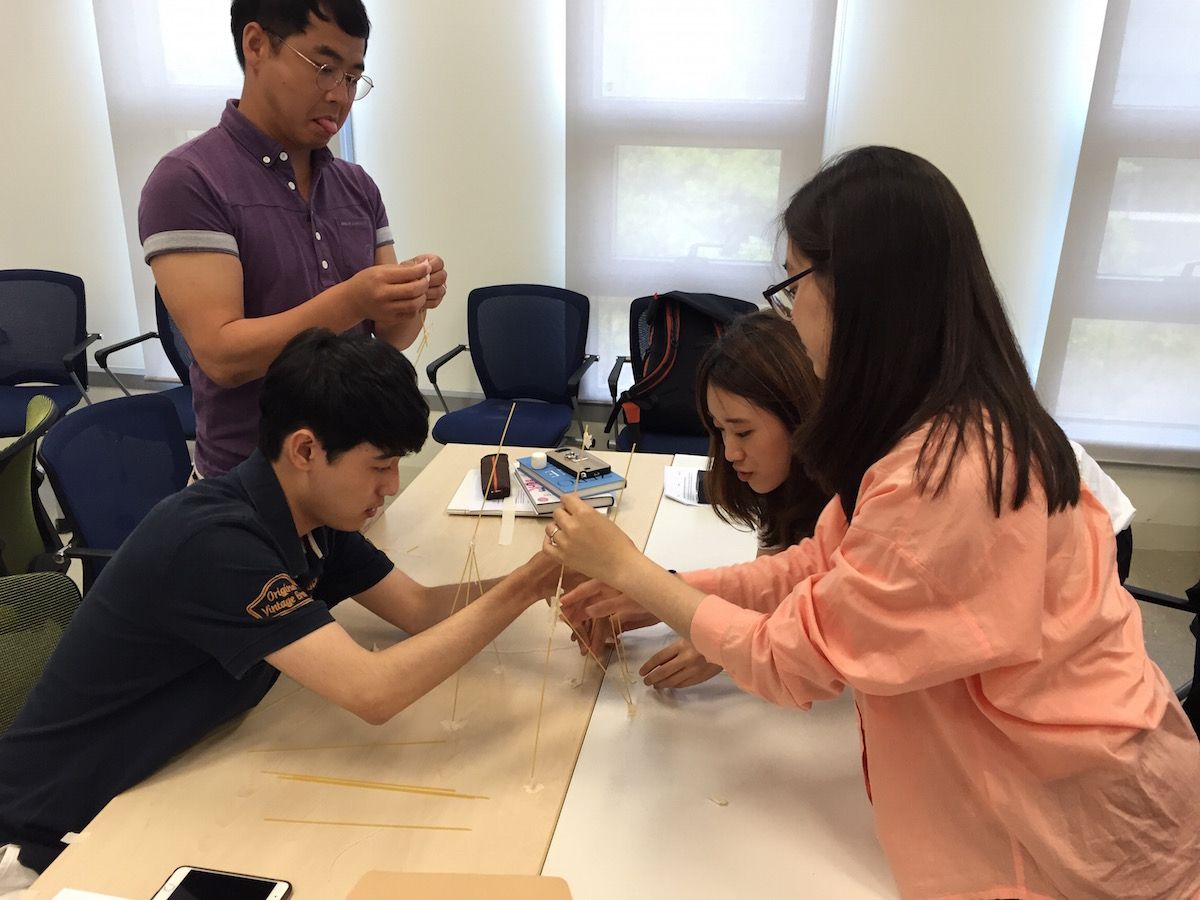
This month I taught a Stony Brook University-listed course called EST 364, "How To Build A Startup." The course was located at the university's Songdo, South Korea campus. This was my first time teaching, and it has certainly been a bit of a wild ride. 36 students are in the class, 35 from Korea University through a special arrangement in their software management program, and one PhD student from SUNY Korea.
My own experience this past week is telling. My challenges started almost immediately when I agreed to teach this class on startups. What should I teach? How should my course be structured? I have five hours of class per day to schedule for two weeks, and I can’t just lob content at students and expect them to understand what is going on, particularly in the summer when expectations for studying are (acceptably) lower.
I knew that I wanted the class to be modern and take into account better learning methodologies, such as more active engagement, project-based learning, and a closer connection between active news in the industry and our work in class.
What I didn't realize is how this is to pull off in reality. There just aren't resources online available or platforms that you can sign up for that allows you to just start using these techniques in class. I was reasonably proficient in using them in the end, but only because I have been in school for 17 years and have seen it done many times. It shouldn't be so hard.
The students did really well with the material, and I think (between this class and others they have taken) that they
Let's call this the slightly late edition of July 2015. This past month been all about travel for my class on startups I am teaching in South Korea. I have posted the materials for this course as well as the syllabus on this website. I was in Korea for a little more than two weeks, and then spent a few days in Taiwan with my TechCrunch colleague Catherine Shu -- my first visit to the country.
Research
Research has been slow due to travel and prep for my class. The most significant work has been building a reading list around quantification, which I will share at some point as I get it closer to completion slash some level of comprehensiveness.
I also discovered in my searching that Trevor Pinch & Richard Swedberg wrote a book called "Living in a Material World: Economic Sociology Meets Science and Technology Studies." It's a weird combo, but also happens to be the two fields that I am studying for my quals. I'll be tracking this down when I get back to the States.
One of my favorite scholars is Benoît Godin, who critically analyzes the term "innovation." He has a bunch of essays on his website, but he also just released a new book from Routledge entitled "Innovation Contested: The Idea of Innovation Over the Centuries." I am looking forward to this, as I think the term and really the whole concept of innovation just hasn't been reflexively analyzed by scholars despite its incredible cultural influence.
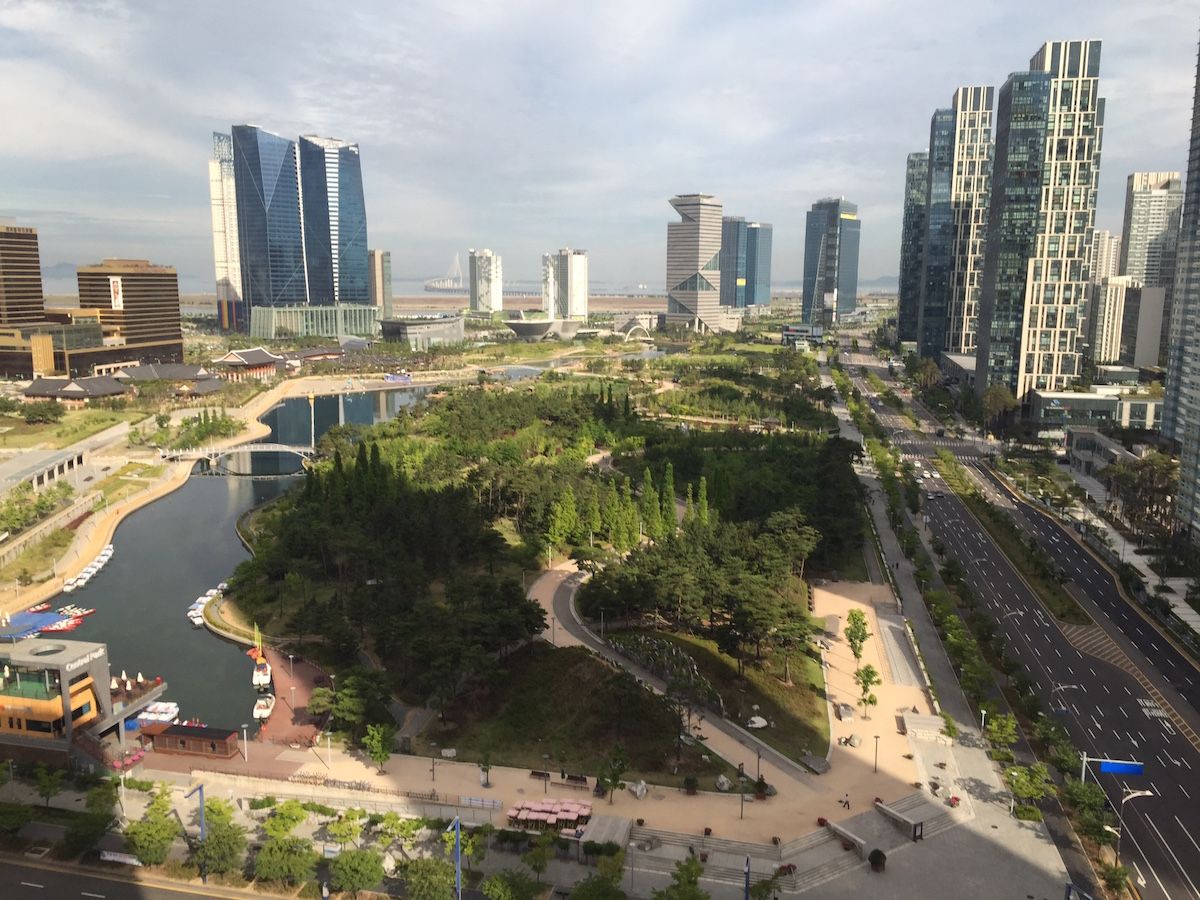
This week, I am visiting Songdo, one of Korea's newest invented cities. I have been here previously before about four years ago, and it is amazing to see how much the region has progressed in just a couple of years. The city is no longer a ghost town -- there are restaurants and cars, with people occasionally walking around. Leave the immediate downtown area though, and it quickly becomes quiet.
It's interesting, but Korea is clearly designing this city with the car at the center of planning. Roads are wide -- 4-5 lanes in each direction for almost all of the major roads, and the intersections are few and far between. It can take as much as 10 minutes walking just to get to the next city block. The city has a single subway line, which isn't all that convenient when the buildings are so far apart.
This really is remarkable. At a time when more cities than ever are trying to grapple with density and rebuilding mass transit, Korea, a country whose record here is world-leading, would seem to be trying to go the opposite way. There are interesting politics to why this city exists in the first place, but at the very least it didn't have to be planned this way.
I get the supposed allure of the "suburban feel." However, Korea's suburbs are just like the suburbs in the west -- mostly devoid of random interaction, and merely an agglomeration of buildings waiting for you to visit with your car. It's all about destinations and not the journey itself, about planning over spontaneity.
I guess this sort of option is needed in Korea, but I hope the country realizes that its future lies in making its cities great, and not sparse utilitarian monstrosities.
One of the on-going projects I am investigating is the use of rankings in society. Rankings are seemingly everywhere -- from college admissions to our workplaces to politics -- and yet, only limited research has been done so far to truly investigate how these rankings are constructed, how they affect the behavior of their subjects, and how they are ultimately used in practice.
In almost all contexts, an objective ranking does not exist. As part of any process of reducing the complexity of life to a number, there has to be prioritization and summarization of data to create the linearity required for a ranking. Thus, we can see in college rankings different motivations behind their constructions. Should high expenses per student be used to show deep resources, or should resources be compared to student outcomes to highlight universities that are most efficient in teaching their students?
Rankings are exciting to me not just because they are everywhere, but that they seemingly work. Publications have long ago figured out that rankings attract huge numbers of readers and viewers, and organizations from lobbying shops to the World Bank now use rankings to push for changes by simply publishing some numbers. To me, few actions seem to have more power than compiling these lists.
This is certainly the case with law schools, which Wendy Espeland and Michael Sauder have investigated extensively in a series of papers. [1] In their research, they show that law schools resisted the initial publishing of rankings for many years, but over time, their effects were imbued into the daily actions of the faculty and staff at these schools. These days, nothing can be done without some reference to US News and what it might do to the rankings.
Hi, I'm Danny. I'm Partner, Research at VC firm Lux Capital, where I publish the Riskgaming newsletter, podcast, and game scenarios. I'm also a Fellow at the Manhattan Institute in New York. I analyze science, technology, finance and the human condition.
Formerly, I was managing editor at TechCrunch and a venture capitalist at Charles River Ventures and General Catalyst.