That's about accurate from everything I have heard (with maybe a little bit of fluctuation in the numbers depending on whether an engineer is at a startup or a large tech company). It's interesting to note how high the entry-level number is for fresh graduates, and also how low the top-end salary is compared to salaries and total compensation in professional services firms.
The second mistake Boston firms make is to consider the city a cheap talent market. It ain't cheap folks. Every single person in Boston has the ability (and often the desire!) to live in one of the world's global cities. Local firms pay significantly less on average than comparable firms in NYC or SF (to the tune of 30-40% based on some recent numbers I have seen). Sure, cost of living is higher in those cities, but it isn't that much higher.
Again, simple solution: pay Silicon Valley market rate. Every time. Regardless of competition. Regardless of anything. You want to retain the talent, you have to pay for that talent. We want the best people here, period. The best cost a lot of money, but thankfully, we have a lot of it lying around.
This is the reason rents in San Francisco are skyrocketing. Engineers from around
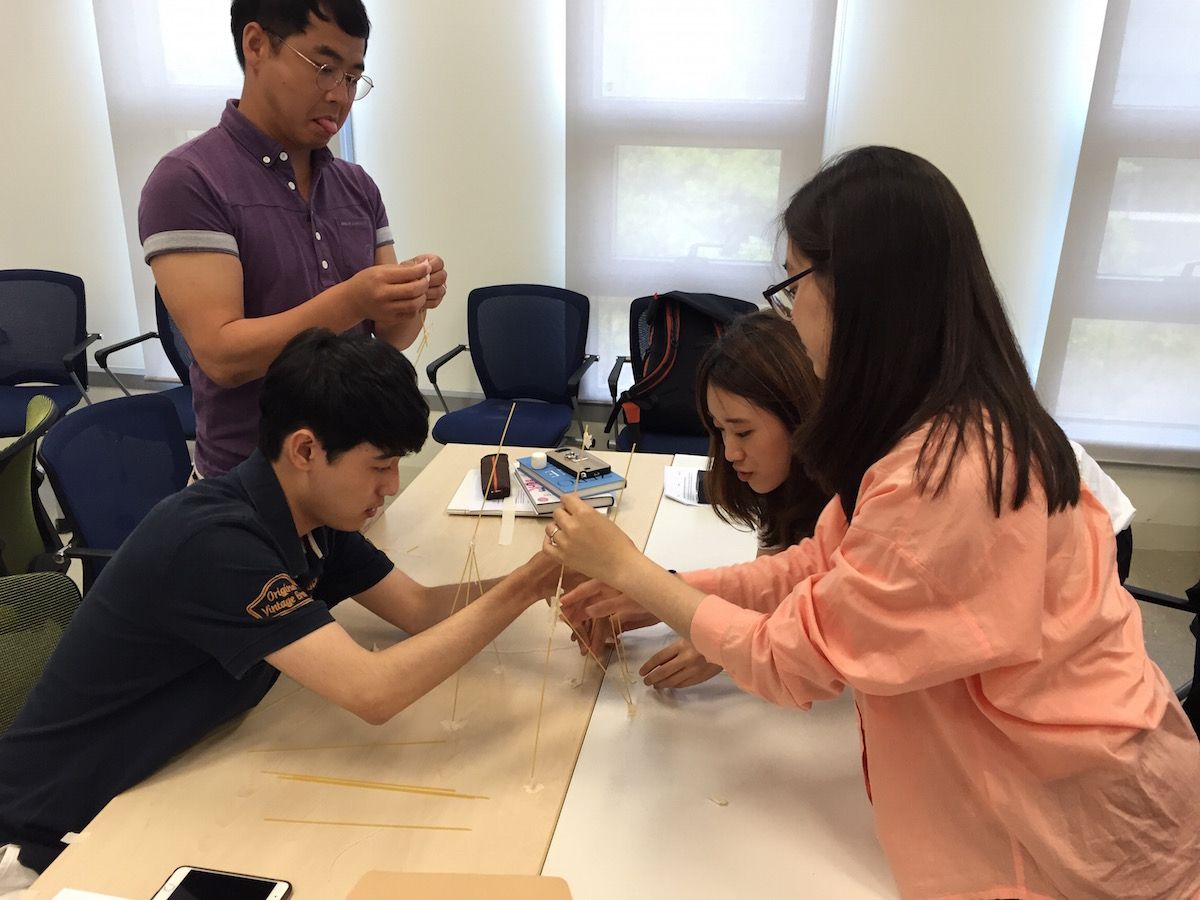
This month I taught a Stony Brook University-listed course called EST 364, "How To Build A Startup." The course was located at the university's Songdo, South Korea campus. This was my first time teaching, and it has certainly been a bit of a wild ride. 36 students are in the class, 35 from Korea University through a special arrangement in their software management program, and one PhD student from SUNY Korea.
My own experience this past week is telling. My challenges started almost immediately when I agreed to teach this class on startups. What should I teach? How should my course be structured? I have five hours of class per day to schedule for two weeks, and I can’t just lob content at students and expect them to understand what is going on, particularly in the summer when expectations for studying are (acceptably) lower.
I knew that I wanted the class to be modern and take into account better learning methodologies, such as more active engagement, project-based learning, and a closer connection between active news in the industry and our work in class.
What I didn't realize is how this is to pull off in reality. There just aren't resources online available or platforms that you can sign up for that allows you to just start using these techniques in class. I was reasonably proficient in using them in the end, but only because I have been in school for 17 years and have seen it done many times. It shouldn't be so hard.
The students did really well with the material, and I think (between this class and
Let's call this the slightly late edition of July 2015. This past month been all about travel for my class on startups I am teaching in South Korea. I have posted the materials for this course as well as the syllabus on this website. I was in Korea for a little more than two weeks, and then spent a few days in Taiwan with my TechCrunch colleague Catherine Shu -- my first visit to the country.
Research
Research has been slow due to travel and prep for my class. The most significant work has been building a reading list around quantification, which I will share at some point as I get it closer to completion slash some level of comprehensiveness.
I also discovered in my searching that Trevor Pinch & Richard Swedberg wrote a book called "Living in a Material World: Economic Sociology Meets Science and Technology Studies." It's a weird combo, but also happens to be the two fields that I am studying for my quals. I'll be tracking this down when I get back to the States.
One of my favorite scholars is Benoît Godin, who critically analyzes the term "innovation." He has a bunch of essays on his website, but he also just released a new book from Routledge entitled "Innovation Contested: The Idea of Innovation Over the Centuries." I am looking forward to this, as I think the term and really the whole concept of innovation just hasn't been reflexively analyzed by scholars despite its incredible cultural influence.
This week, I am visiting Songdo, one of Korea's newest invented cities. I have been here previously before about four years ago, and it is amazing to see how much the region has progressed in just a couple of years. The city is no longer a ghost town -- there are restaurants and cars, with people occasionally walking around. Leave the immediate downtown area though, and it quickly becomes quiet.
It's interesting, but Korea is clearly designing this city with the car at the center of planning. Roads are wide -- 4-5 lanes in each direction for almost all of the major roads, and the intersections are few and far between. It can take as much as 10 minutes walking just to get to the next city block. The city has a single subway line, which isn't all that convenient when the buildings are so far apart.
This really is remarkable. At a time when more cities than ever are trying to grapple with density and rebuilding mass transit, Korea, a country whose record here is world-leading, would seem to be trying to go the opposite way. There are interesting politics to why this city exists in the first place, but at the very least it didn't have to be planned this way.
I get the supposed allure of the "suburban feel." However, Korea's suburbs are just like the suburbs in the west -- mostly devoid of random interaction, and merely an agglomeration of buildings waiting for you to visit with your car. It's all about destinations and not the journey itself, about planning over spontaneity.
I guess this sort of option is needed in Korea, but I hope the country realizes that its future lies in making its cities great, and not
One of the on-going projects I am investigating is the use of rankings in society. Rankings are seemingly everywhere -- from college admissions to our workplaces to politics -- and yet, only limited research has been done so far to truly investigate how these rankings are constructed, how they affect the behavior of their subjects, and how they are ultimately used in practice.
In almost all contexts, an objective ranking does not exist. As part of any process of reducing the complexity of life to a number, there has to be prioritization and summarization of data to create the linearity required for a ranking. Thus, we can see in college rankings different motivations behind their constructions. Should high expenses per student be used to show deep resources, or should resources be compared to student outcomes to highlight universities that are most efficient in teaching their students?
Rankings are exciting to me not just because they are everywhere, but that they seemingly work. Publications have long ago figured out that rankings attract huge numbers of readers and viewers, and organizations from lobbying shops to the World Bank now use rankings to push for changes by simply publishing some numbers. To me, few actions seem to have more power than compiling these lists.
This is certainly the case with law schools, which Wendy Espeland and Michael Sauder have investigated extensively in a series of papers. [1] In their research, they show that law schools resisted the initial publishing of rankings for many years, but over time, their effects were imbued into the daily actions of the faculty and staff at these schools. These days, nothing can be done without some reference to US News and what it might do to the rankings.
I just finished reading Lauren Rivera's Pedigree: How Elite Students Get Elite Jobs, and I have to say it was a highly interesting read into the internal dynamics of hiring at what she calls elite professional services (EPS) firms like Goldman Sachs and McKinsey.
Her argument is simple: while sociologists have heavily focused on elite reproduction through universities (what might be termed the "Harvard" thesis), the reality is actually more complicated. Getting admission to a top school is insufficient to guarantee entrance to the elite. Rather, elites are generated partly as part of the process of entering the labor markets, namely through EPS firms.
Much of the book is devoted to her fieldwork working at one of these firms and describing each of the stages of the interview process for new graduates. We see constantly that definitions of cultural fit are key to getting hired, and that these definitions tend to be similar (although not identical) to the culture of elites. In other words, firms hire elite students from elite backgrounds not because of their parentage, but because of the social norms and cultural capital those parents provided. In this mission of illuminating inequality at the upper-end of the income spectrum, the book does an admirable job.
However, I felt the book did not probe deep enough into why these firms hire the way they do. Rivera makes the point that almost none of the EPS firms actually keep track of their applicant data and connect it with actual on-the-job work outcomes, particularly at law firms where interviews were entirely unstructured. How do they get away with this? Having written about one startup in this space, why have competitors been unable to disrupt this industry (at least so far)?
I am starting a new monthly post where I share what I have been working on what I am hoping to work on shortly. This is the first edition. If you see something you think is interesting, don't hesitate to email me.
Research
I posted a copy of a working paper I did as a term paper for Economics of Science. The paper looks at the Pentagon's research budget over the past twenty years, and how it has moved money between basic and applied science. One really interesting facet of the budget data is just how large of an impact presidential initiatives have on this budget (one example: the Bush missile shield). This was sort of a side project, but I think the data is interesting, and there are lots of opportunities for follow ups if anyone is interested.
I am doing a historical study of the rise of public policy schools and their curriculums. One example of this research is a post I wrote two weeks ago about how economics became the center of public policy due to its perceived legitimacy within Harvard. I am really interested in epistemology in public policy, and why we continue to use a narrow set of tools rather than a richer one.
My larger research project looks at the creation, dissemination, and growth of rankings and other ordinal measures of performance. As quantification becomes increasingly popular in everything from business to politics, I believe there needs to be increasing skepticism and critical analysis of precisely how these measures get created and used. This is part of a long discourse on power and knowledge. One great new book on this is The Quiet Power of Indicators which discusses how indicators like Freedom House's came into being and how they are used
ProPublica's report on the Red Cross' horrific mismanagement of aid dollars in Haiti should not be surprising to anyone who has followed development studies over the past two decades (and really, the antecedents go much further back).
The quotes though don't get much worse than this:
One issue that has hindered the Red Cross’ work in Haiti is an overreliance on foreigners who could not speak French or Creole, current and former employees say.
And
None of that ever happened. Carline Noailles, who was the project’s manager in Washington, said it was endlessly delayed because the Red Cross “didn’t have the know-how.”
And
“They collected nearly half a billion dollars,” said a congressional staffer who helped oversee Haiti reconstruction. “But they had a problem. And the problem was that they had absolutely no expertise.”
And
“Going to meetings with the community when you don’t speak the language is not productive,” she said. Sometimes, she recalled, expat staffers would skip such meetings altogether.
Ad nauseum.
This is exactly the sort of situation that we can expect when development studies ignores the importance of actual situational knowledge of the land in which an aid organization operates. Yet, academic programs focused on development eschew area studies in favor of economics, since these are "practical" skills that are supposedly "universal."
Economics is actually the easy part of developing a country. It's obvious (in most cases) what the problems are: chronic lack of housing, chronic malnourishment, bad sanitation, poor infrastructure, and the list goes on. The hard part is going from objectives to actual actions on the ground where culture and local dynamics will play the decisive role in the success or failure of the mission.
Hi, I'm Danny. I'm Partner, Research at VC firm Lux Capital, where I publish the Securities newsletter and Riskgaming. I'm also a Fellow at the Manhattan Institute in New York.
Formerly, I was managing editor at TechCrunch and a venture capitalist at Charles River Ventures and General Catalyst.