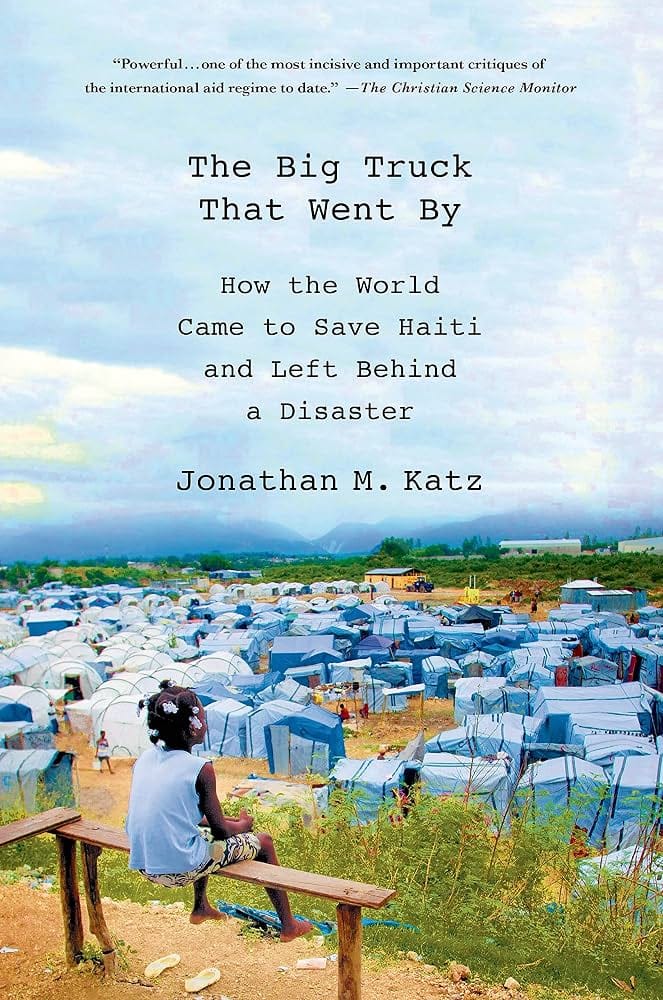
It’s extraordinarily pleasing to read field reporting from deeply embedded foreign correspondents, a vocation that is shamefully underfunded today given the myriad of crises engulfing the world. Even more scintillating is when those same correspondents transform their routine work into a synthesized volume, offering us both a panoramic view into another place that far exceeds the space of a clip and the measured restraint of judgment that comes from patience gained outside the news cycle.
Jonathan M. Katz was the AP news reporter for Hispaniola based out of Santo Domingo, Dominican Republic and ultimately moved to Haiti’s capital of Port-au-Prince full-time to report on the Western Hemisphere’s most immiserated country. It’s a tough assignment complete with roving gangs, random violence and regular power outages that makes the AP house-cum-office nestled next to one of the prestige expat hotels a mountaintop island of bare tranquility.
Haiti rarely makes headlines, and for a while, Katz’s clips rarely disseminated into the AP’s member publications. Having nearly completed his tour of duty, Katz begins preparations to depart for a new assignment, which his editor jokes will be a safer place like Kabul or Abuja, Nigeria. As he starts to prepare for the transfer, his tough assignment becomes even harder and yet more important when on January 12, 2010, a powerful earthquake rocked the nation, killing tens of thousands of Haitians in one of the worst natural disasters of the new millennium.
For the first half of the book, we follow Katz and his redoubtable and improvisational news assistant Evens as they drive all over Port-au-Prince in search of ground truth in the midst of extraordinary tragedy. Far from the gauzy memoirs that might be possible in such a work, Katz emphasizes the personal human toll of the tragedy, particularly how Evens ends up driving toward his family and friends in search of survivors rather than straight for the presidential palace where an intrepid news team might be expected to secure a meaningful scoop.
There are moments of sheer frustration. With cell service intermittent to nonexistent, the two head to the U.S. Embassy, but given security procedures and demented bureaucracy, it refuses to allow them to use their still-functioning communications system. They end up sleeping on the floor in the embassy’s guard shack since they aren’t allowed on the premises, which are lit up against total darkness thanks to backup generators.
Then there is the country’s president, René Préval. He’s a long-time political survivor in an otherwise Game of Thrones-esque political system, and part of his strength is his determined aloofness. It’s a useful approach in the quotidian political struggles of a failing state, where the ability to make an agile pivot can be the difference between holding power and being killed in a coup. Yet, his ingrained habit is a gargantuan failure in the midst of immediate tragedy. It takes days for Préval to be seen in public, a lack of leadership that is nothing short of astonishing amidst the rubble, including that of the National Palace itself.
Katz narrates the journalistic highs and lows of scoops and updates, before turning to a more rounded view of Haiti’s modern political history and the sources of poverty that led to millions living in the equivalent of shanties completely incapable of sustaining themselves against an earthquake. Haiti is not located in an active earthquake zone like Japan, but it is a part of a string of islands in the Caribbean that was formed from the subduction of two continental plates pushing against each other. In other words, the “big one” is an ominous, once-a-century threat that otherwise has no purchase on daily life. It’s exactly the kind of crisis that Haiti’s government has no means to prepare for.
It’s also a crisis that Katz himself hadn’t prepared for. He writes an interlude toward the center of the book describing heading to his hometown in the States and discussing his reporting in Haiti with a therapist. It’s clear that he is facing symptoms of PTSD, and he offers a rare authenticity on the extreme emotional and mental costs from the kinds of disaster and war reporting that are so vital but so damaging to the reporter themselves.
Much of the middle of the book focuses on the incompetence of the response to the Haitian quake from the United States and the United Nations. Here, Katz offers great reporting, although his more analytical comments are tougher to swallow. He’s cynically brilliant at pointing out the tradeoffs facing U.S. officials: they want to be seen as helping Haiti, but at the lowest cost possible to assuage domestic blowback. So, for instance, President Obama and his administration announce loan forgiveness to Haiti — forgiveness of loans that weren’t going to be repaid even in the best of possible circumstances. It’s a splashy number, but more accounting legerdemain than humanitarian intervention.
Of the actual aid dollars, the vast majority of it never reaches Haiti. Katz describes in vivid and enervating detail the crime of the modern humanitarian system: the dollars are spent at home on food and provisions, juicing up the donor economies at the expense of Haiti’s own. By his calculation, upwards of four of five dollars are spent domestically before anything reaches Haiti. One scarcely has to research why the country hasn’t escaped its poverty trap given such a system.
On the other hand, he aggressively supports handing more money to the Haitian government directly instead, arguing that NGOs in the country end up spending what little actually arrives in Haiti proper on their own administrative costs. It’s frustrating: the NGOs spend all the money on themselves, but Haiti’s government is a bastion of corruption. On the latter, Katz’s arguments to the contrary ring startlingly hollow. There’s really no way to spend aid effectively in the country, a combination of non-profit avarice and a lack of state capacity. None of this can be fixed fast enough in the aftermath of an earthquake.
We ultimately proceed a few months later to the largest scandal of the book, which is the accidental spread of cholera in Haiti by United Nations troops dispatched from Nepal. Haiti (and much of the Caribbean and the Americas) has no history of cholera at all — there’s simply no Vibrio cholerae bacteria to infect anyone. Yet at the time, there is a large outbreak in Nepal underway, a fact unknown locally.
Per journalism’s own Murphy’s Law, Katz is on a rare vacation when word gets out that there has been a serious outbreak of some sort of illness and that hundreds are dead in the early hours. International public health officials had been worried for months that an epidemic of something could happen after the disaster, although Katz argues that the evidence shows that natural disasters and other calamities do not raise their risk. He ultimately cuts short his vacation and heads back to investigate.
It’s here that any reader will become an impassioned hater of the remorseless bureaucracy that is the postwar international system. Katz visits the base of the Nepalese UN troops to find that their wastewater is dumping straight into the river located meters away — river water that is crucial for drinking and bathing. It’s obvious that the cholera cases are concentrated downstream, and that the UN facility has also paid a corrupt contractor that is doing little to fulfill its health mandates.
Over the course of the coming weeks, the UN dissembles. First, it’s a flat denial, and then we see an echo of an argument straight from Covid-19’s lab leak debate. Public health officials — including the World Health Organization — start to understand the truth of the situation, and then they argue that it’s critical to avoid blaming anyone for the novel cholera outbreak since the focus should be on response, not investigation.
Katz vociferously fights back against this truculence, convincingly pointing out that knowing the cause of an epidemic is the first step to mitigate its damage. He is notably caustic about The New York Times reporter Donald G. McNeil Jr., who pushes back against “the blame game” in his late but impactful coverage of the epidemic. McNeil wrote, “And the ‘fault’—if that’s the word—often lies just as much with the victims as with the vectors.” In other words, only the Haitians have themselves to blame for a foreign epidemic from foreign soldiers showing up in humanitarian caravans.
Even amidst the audacious stupidity of international do-gooders and observers, it’s a jaw-dropping, what-the-fuck comment. And printed in the paper of record as well.
Katz goes on a fair rampage:
As for provoking the feared Haitian crowds, weeks of watching the mission stonewall bolstered most Haitians’ already strong belief that the UN had imported cholera. By refusing to engage, the investigators ceded inquiry to agitators and xenophobes. Everyone lost an opportunity to get a scientific answer that could have calmed fears and furthered the fight against disease, and the powerful nations that had been working in Haiti lost an opportunity to demonstrate to the Haitian people that they took their lives and welfare as seriously as their own.
Once again, such sentiment could easily have been written in the aftermath of Covid-19.
Katz ends the chapter writing, “But scientists fear that cholera has become endemic in Haiti. It will likely never go away.” Indeed, with more than a decade of further hindsight, his and these scientists’ fears have been realized. Last year, Haiti experienced another outbreak of cholera, with several thousand cases and dozens of deaths. That’s all to blame on a UN system that couldn’t treat its wastewater to its own mandated health standards. All told, nearly 10,000 Haitians died from upwards of a million cases. The connection to Nepal is mostly credited to Katz and his intrepid reporting.
The book rounds out with the Haitian presidential election, and the on-going plangent calls for rebuilding. Once again with hindsight, we know how the story goes: Haiti is arguably in worst shape than ever, with violent gangs and international provocateurs even more powerful than ever before — so powerful, in fact, that the country’s president, Jovenel Moïse, was killed in his own home in 2021. His wife and a former prime minister were charged with conspiracy in what was a brutal political assassination.
There’s little in the book that will make one optimistic, save the hospitality and ultimate humanity of so many of the supporting cast, namely, the Haitian people themselves. In the midst of widespread tragedy, so many of them worked together in mutualistic ways to try to make the best of a terrible plight. It’s a heartfelt and earnest view, but Katz’s true value is in looking at the horrors and simply writing down the details, one field report at a time.